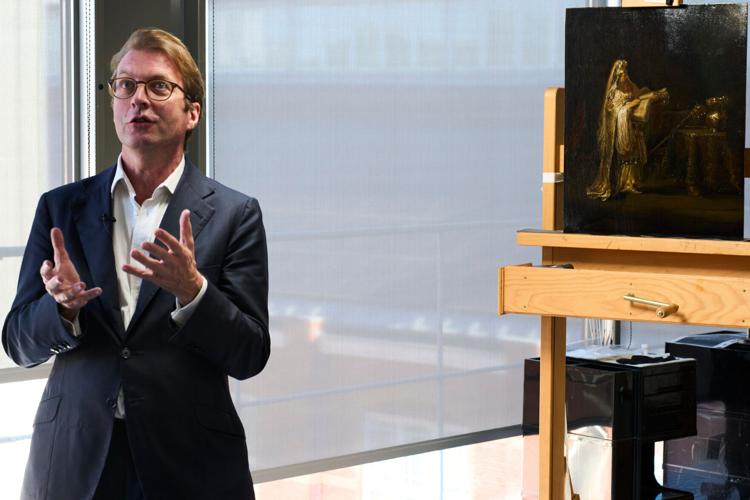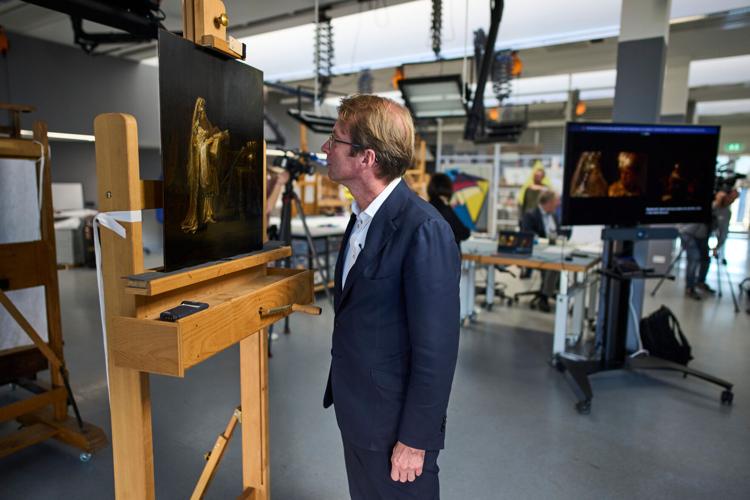

The Rijksmuseum unveiled the work "Vision of Zacharias in the Temple" during a press preview in Amsterdam, Netherlands, on March 2 and said two years of analysis confirmed it was painted by Rembrandt.
THE HAGUE, Netherlands — A painting that was once rejected as a work by Rembrandt van Rijn has now been acknowledged as a work by the Dutch master, thanks to two years of scrutiny in the city where the then-27-year-old artist painted it in 1633.
The Netherlands' national art and history museum, the Rijksmuseum, unveiled the work, "Vision of Zacharias in the Temple," and said painstaking analysis, including high-tech scans, has confirmed it was painted by Rembrandt after he moved to the capital, Amsterdam.
The painting hasn't been on public display in decades after being bought by a private collector in 1961, a year after it was deemed not to be a Rembrandt, the museum said in a statement. Starting Wednesday, it has gone on display among other masterpieces at the Rijksmuseum, where it is on long-term loan.
Director Taco Dibbits said the museum often receives emails from people asking whether the painting they own might be by the Golden Age master.
People are also reading…

Director Taco Dibbits of the Rijksmuseum unveiled the work "Vision of Zacharias in the Temple" during a press preview in Amsterdam, Netherlands, on March 2 and said two years of analysis confirmed it was painted by Rembrandt.
"We always hope to find a new Rembrandt, but this happens rarely," he told The Associated Press. He said making such a discovery "is just like (finding) a needle in a haystack."
The owner, who has remained anonymous, initially asked the museum only if the painting was Dutch.
"He really didn't know what he had. And then to discover that it's a Rembrandt is something that's amazing to experience," Dibbits said.
The painting depicts a biblical story in which the high priest Zacharias is visited by the Archangel Gabriel, who tells him that he and his wife will have a son: John the Baptist. Zacharias' surprised expression is highlighted by light heralding the arrival of Gabriel, the museum said.

Director Taco Dibbits of the Rijksmuseum unveiled the work "Vision of Zacharias in the Temple" during a press preview in Amsterdam, Netherlands, on March 2 and said two years of analysis confirmed it was painted by Rembrandt.
An in-depth study of the work, including macro X-ray fluorescence scans and comparisons with other works by the artist, confirmed Rembrandt painted it, said the museum's curator of 17th-century Dutch paintings, Jonathan Bikker.
"So the wood that was used for the panel on which it's painted, that is definitely from a tree that was cut down before 1633, the date on the painting," he said.
"All the pigments, the paint in the painting were used by Rembrandt in other paintings. And the layers of paint and how he painted it, that is also precisely the same as in other works by Rembrandt," he added.
The work joins about 350 known Rembrandt paintings and raises the hope that there may be more.
"We're not actively looking for new paintings by Rembrandt, but I think this gives us hope — not just us, but everyone who's interested in Rembrandt," Bikker said.
Making Italy's art accessible to people with disabilities

Giorgio Guardi, center, a guide from the Radici Association, walks with participants Nov. 29 during an inclusive art tour in Rome.

Michela Marcato, left, who is blind, and her partially sighted partner, Massimiliano Naccarato, examine a scale model of the Colosseum on Dec. 17 with Giorgio Guardi, right, a guide in inclusive tourism, in Rome.

Michela Marcato, who is blind, runs her fingers over a tactile panel Dec. 17 during a visit to the Colosseum in Rome.

Michela Marcato, left, who is blind, and her partially sighted partner, Massimiliano Naccarato, pose for a photo Dec. 17 during a visit to the Colosseum in Rome.

From left, Stefania Terre touches a reproduction of Michelangelo's sculpture La Pieta with Monica Bernacchia and Carmine Laezza during a Jan. 15 tour for blind people at the Omero Tactile Museum in Ancona, Italy.

A light worn on the hands of Stefania Terre, who is blind, streaks across a life-size reproduction of Michelangelo's La Pieta as she touches the sculpture for a long-exposure photograph Jan. 15 at the Omero Tactile Museum in Ancona, Italy.

Stefania Terre, left, and Carmine Laezza, far right, both blind, touch a reproduction of St. Peter's Basilica on Jan. 15 at the Omero Tactile Museum in Ancona, Italy.

Stefania Terre, who is blind, touches a reproduction of St. Peter's Basilica on Jan. 15 at the Omero Tactile Museum in Ancona, Italy.

Stefania Terre, who is blind, touches a life-size reproduction of the head of Michelangelo's David during a Jan. 15 visit to the Omero Tactile Museum in Ancona, Italy.

Stefania Terre, who is blind, uses a small light on her fingers while touching a life-size reproduction of the head of Michelangelo's David for a long-exposure photograph Jan. 15 at the Omero Tactile Museum in Ancona, Italy.

Blindfolded students of an art high school enter the pavilion of contemporary art Jan. 16 for a project on tactile experience at the Omero Tactile Museum in Ancona, Italy.

A blindfolded student of an art high school touches a piece in the pavilion of contemporary art Jan. 16 during a project on tactile experience at the Omero Tactile Museum in Ancona, Italy.

Massimiliano Trubbiani, an expert in tactile education for blind and visually impaired people, works to transform Titian's Pala Gozzi into bas-relief Jan. 16 in a laboratory at the Omero Tactile Museum in Ancona, Italy.

Massimiliano Trubbiani, an expert in tactile education for blind and visually impaired people, works to transform Titian's Pala Gozzi into bas-relief Jan. 16 in a laboratory at the Omero Tactile Museum in Ancona, Italy.

A painting transformed into bas-relief is displayed Jan. 16 at the laboratory of tactile education at the Omero Tactile Museum in Ancona, Italy.

Felice Tagliaferri, a blind sculptor, stands Jan. 16 in his studio in Cesena, Italy.

Powder covers the hammers of Felice Tagliaferri, a blind sculptor, on Jan. 16 in his studio in Cesena, Italy.

Daria Portale, a guide with the Radici Association, uses a tactile panel so Enrico Sulli, right, who is blind, can experience the architecture of Palazzo Farnese during a Nov. 29 inclusive art tour in Rome.

Francesca Inglese, who is blind, touches a marble relief Nov. 29 on the corner of a building during an inclusive art tour in Rome.

Francesca Inglese, who is blind, uses a tactile panel to experience the architecture of Palazzo Farnese during a Nov. 29 inclusive art tour in Rome.

Elena Dominici, who is blind, touches the Cancelleria fountain Nov. 29 during an inclusive art tour in Rome.