



鈥楬appy New Year,鈥� the recognizable voice barked into my phone鈥檚 earpiece.
It was my long-time imaginary friend, I.K. Bruto, who calls from time to time to chastise or challenge me. His voice, however, sounded unusually happy. He usually sounds like someone eating a saladito for the first time.
鈥淚鈥檓 in a great mood,鈥� he sang out.
I don't believe it. Next he鈥檚 gonna tell me that the polar vortex froze over the Santa Cruz River.
鈥淲e鈥檙e going to get a park,鈥� he said excitedly, as if he were cheering for the old Wildcats men鈥檚 basketball teams that once steamrolled Tempe U.
Really? We should talk, I told him. I asked him to meet me.
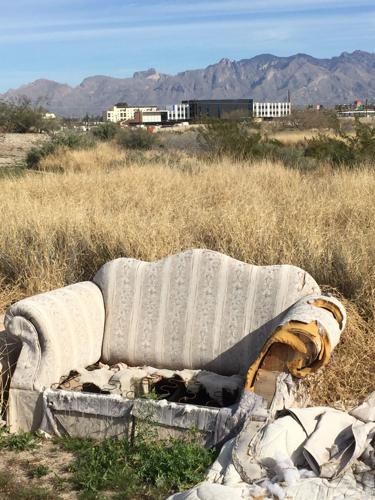
Minutes later, I drove out to the base of Sentinel Peak and parked. I walked over to an abandoned sofa sitting on what was once a city dump in the 1950s and into the early 鈥�60s. Bruto was relaxing on the tattered furniture under a gloriously bright sky, gazing upward to the 鈥淎鈥� as if he were inside Mission San Xavier del Bac.
People are also reading…
鈥淭here may be nothing here now,鈥� he said, sweeping his arm across the vacant land with a smattering of debris, some grass and a few trees. In the background is the nearly finished subsidized Caterpillar building and resurgent downtown. 鈥淏ut it鈥檚 gonna be a Sonoran Desert park,鈥� he added, 鈥渙n the site of Tucson鈥檚 birthplace.鈥�
My normally grumpy friend was suddenly Mr. Sunshine. He was aglow in the wake of a decision Tuesday by the Rio Nuevo board, which controls the fate of the land, giving its preliminary blessing to creating a Sonoran Desert park on 29 acres, south of West Mission Lane and east of South Grande Avenue.
鈥淚t is historic land,鈥� Bruto said, his voice drowning out the hum of passing cars. 鈥淚t鈥檚 been inhabited by people for thousands of years,鈥� he went on:
鈥淔irst were the indigenous people who roamed and began cultivating along the river, then the Spanish colonos who built a convento and granary, followed by Mexican farmers, who were later joined by anglo, Chinese and African-American families. All this here and we don鈥檛 value it,鈥� he said, winding down.
But we do value it, I said in a clear, sarcastic voice. We let the colonial structures disappear and years later we created three dumps, of which 鈥淎鈥� Mountain was the largest, I said.
I continued: The future looked up when voters in 1999 approved the original Rio Nuevo plan that called for the creation of cultural and historical interpretive structures and museums that would tell the history of the land and the people.
But that all crashed when the city mishandled Rio Nuevo uno and the state intervened, creating Rio Nuevo dos with the mandate to make money.
鈥淪o how appropriate that 20 years after city voters said yes to promoting and preserving Tucson history and culture, maybe we can start envisioning a park,鈥� said Mr. Optimistic. 鈥淐ouple the park with the existing Mission Garden and rebuilding of the Carrillo House along Mission Lane, and the creation of the S-cukson indigenous interpretive site and the adjoining Mission complex, much of the original Rio Nuevo plan can and should be made a reality,鈥� Bruto said.
鈥淚 like the sound of it,鈥� he said of his own voice.
Well, I told Bruto, I hate to cloud your sunny outlook, but I鈥檓 skeptical.
The initial park plan calls for the Pima County Flood Control District to remove 85,000 cubic yards of sediment from the river in a cleanup and flood-prevention project, and spread the sediment over the landfill. This would act as a buffer to the landfill鈥檚 underground methane gas and allow desert plants to grow.
The landfill would be shaped and contoured, vegetation would be planted and a park would take shape. Meanwhile, the Rio Nuevo district, neighbors, preservationists and likely city and county officials can talk about and plan the park鈥檚 future.
However, this is contingent on a final agreement between Rio Nuevo and the county, I told Bruto. Moreover, I added, there remains a strong sentiment among some Rio Nuevo board members to commercially develop the landfill. But a major obstacle to development is that the cost to build more apartments and retail or convert the landfill to some other commercial use would be prohibitive. It would cost millions to remove the sediment and contaminated soil and replace it with clean infill.
In fact, the city of Tucson is filling in about 6.5 acres of land it owns on Cushing Street, just west of the nearly completed Caterpillar regional building, I explained to Bruto. That land is zoned industrial and is likely to be developed, as more construction is coming to the Mercado San Agust铆n commercial and residential area north of the landfill along West Congress Street, I told him.
鈥淪o, Mr. Cheerleader, you don鈥檛 think the park will be built?鈥� Bruto asked me.
I didn鈥檛 know how to respond, so I walked away, leaving Bruto to marvel at a sunny winter sky.
Let鈥檚 just say I hope the park comes before ice covers the Santa Cruz.
Ernesto “Neto” Portillo Jr. is editor of La Estrella de Tucsón. Contact him at netopjr@tucson.com or at 573-4187.


