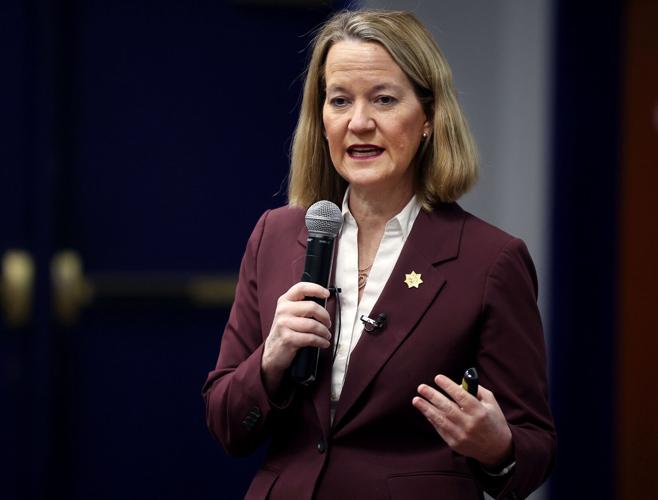
Dozens of Tucsonans came out to a spirited town hall held by Arizona Attorney General Kris Mayes on her office's efforts to intervene in Tucson Electric Power's request for a 14% rate increase.
Mayes, who previously served on the Arizona Corporation Commission, said Arizonans are already feeling squeezed by rising costs of their utility bills. She called TEP's rate increase "blatant corporate greed."
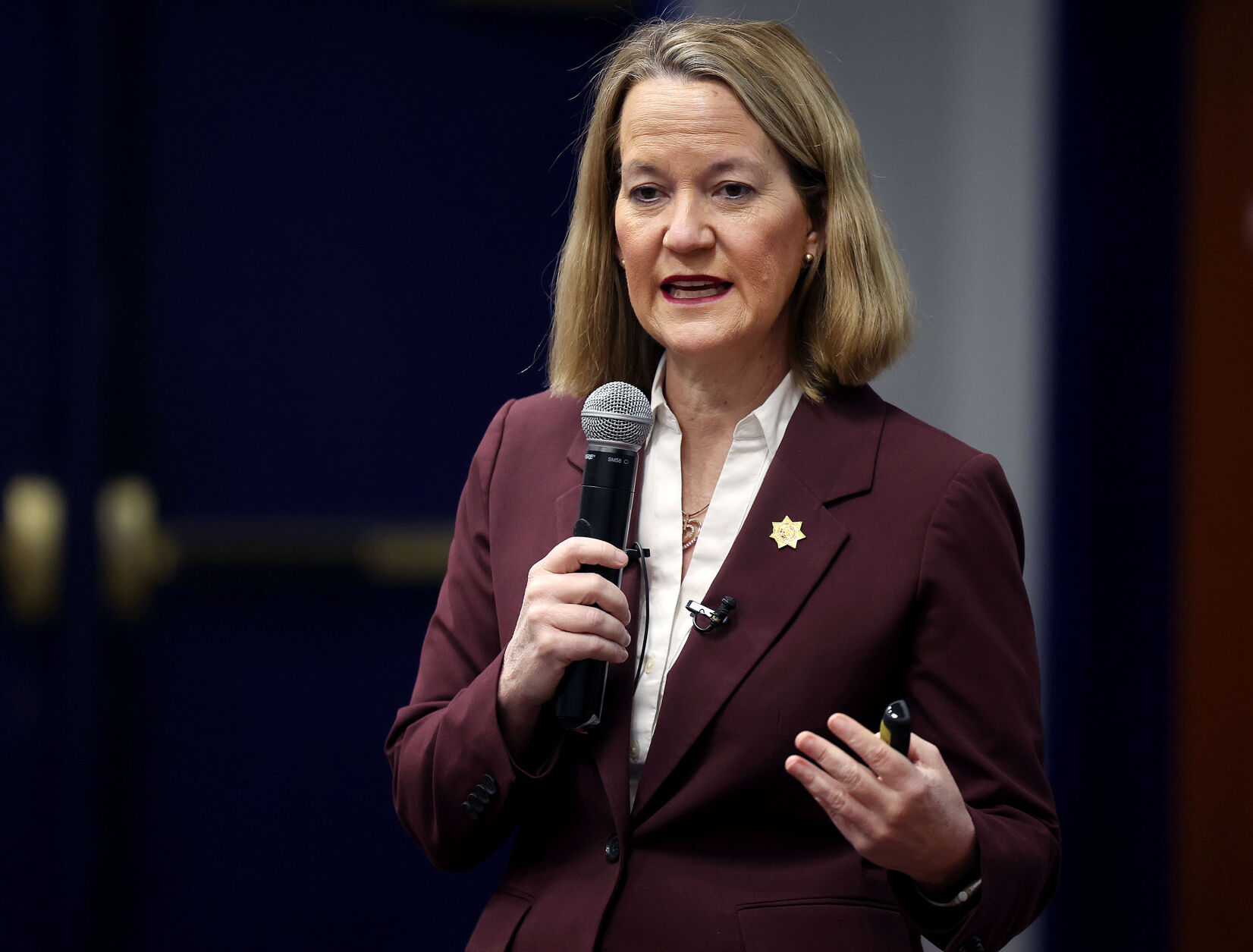
Arizona Attorney General Kris Mayes speaks during a town hall on Tucson Electric Power’s requested rate increase, which she held Tuesday at the YWCA, 525 N. Bonita Ave.Â
"As a former Arizona corporation commissioner, I've never seen anything like we are seeing right now with most of the major utilities in the state of Arizona," Mayes, a Democrat, said to the crowd gathered Tuesday at the YWCA of Southern Arizona. "We are watching a monopoly utility try to abuse the system. Tucson consumers cannot choose a different electricity provider unless they sell their homes and move."
People are also reading…
In June last year, TEP announced it was seeking the 14% rate increase for residential customers. On average, the increase would add about $16 per month — $192 per year — to electric bills for households with a median usage of 638 kilowatt-hours per month.

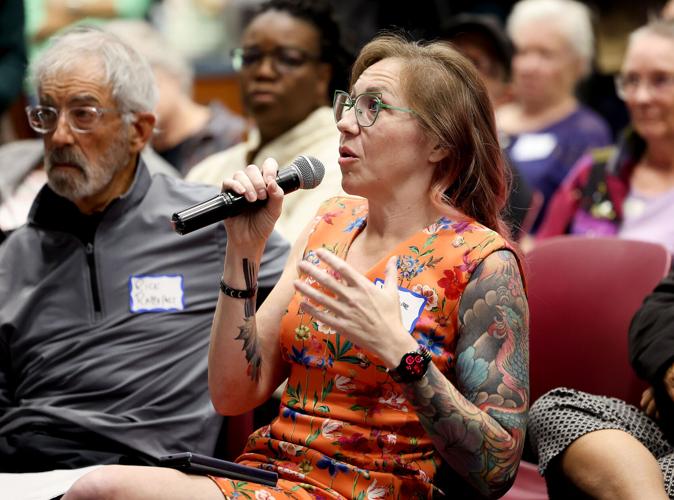
Jackie McGuire asks a question of Arizona Attorney General Kris Mayes during Mayes' town hall Tuesday on TEP's rate increase request.Â
The announcement from TEP came just hours after the Pima County Board of Supervisors voted to sell a 290-acre parcel of county-owned land for the massive data-center complex known as Project Blue. Spokespeople for TEP have said repeatedly that the utility's filing for the rate increase resulted from the timeline associated with developing new rate proposals and had nothing to do with Project Blue.
Mayes also announced this month that her office will contest the ACC's approval of the energy service agreement between TEP and Project Blue developers, saying the agreement illegally gives the two parties the power to set electricity rates for Project Blue's data centers, apparently without the state's approval, which she said violates the state Constitution. Mayes singled out a provision she said would allow the utility and Project Blue owners and operators to set the rate the project pays for electricity, creating a loophole "and a dangerous recipe for massive price hikes for Arizona consumers."
TEP, in a news release Monday, challenged Mayes' accusation without calling her out by name.
"The implication that we can set secret rates in a back room without approval from the Arizona Corporation Commission (ACC) is patently false. The project will pay for service under TEP’s ACC‑approved tariff for customers served at the utility’s highest retail voltage," the utility said. TEP also said no customer sets their own rate, no deviation from ACC-approved tariffs is allowed without the commission's approval, and that any future tariff adjustment "must go through the same public ACC approval process used for all customers."
"TEP nor the customer can create or apply an unapproved rate," TEP said in its news release. "Arizona law prohibits it. Arizona law requires any new tariff proposal to be reviewed and approved by the ACC. Such a review ensures no hidden cost shifts to other customers. The contract also makes clear that all terms, conditions, and obligations for both TEP and the data center developer are governed by Arizona law. In short, the idea that an unapproved rate could be used simply has no grounding in fact."
TEP President Erik Bakken said recent statements attacking the agreement between the utility and Project Blue developers "are false and at the very least misleading."
"Our customers deserve honest, accurate information about decisions that affect their energy future," Bakken said. "Public dialogue is healthy, but it must be grounded in accurate information."
Several residents spoke out Tuesday on a wide range of topics during the town hall, from the rate increase itself to the rise of data centers in Southern Arizona.
Soleste Lupu, who co-owns the nonprofit ballet studio  in South Tucson, said children attending her studio are from low-income families that are stretched thin already. She said when rate increases are felt as a business, her studio has no way of passing the costs on to those families.
"What that means for me as a business owner, and as a resident, is that those families now no longer are able to use my business there. ... I don't understand why the Arizona Corporation Commission has stopped representing the people of Pima County in Arizona," she said. "What power do we have to say, other than a vote, to say you're not representing our voice?"
"How are we being represented? ... I am tired of not having a voice," Lupu said.
Jackie McGuire, a Marana resident, asked the Attorney General's Office to look into the plans for Marana data centers as well, in addition to the Project Blue plans on the Tucson area's southeast side. McGuire had spoken out during the Marana Town Council meeting last week in which nearly 600 acres were rezoned to pave the way for two data center campuses to be built by Project Blue developers.
After the Marana Town Council meeting, a push for a referendum on the council's decision was filed. If enough signatures are collected, the referendum could make its way to a ballot for voters to consider the rezoning.Â
McGuire said she spoke at Mayes' town hall Tuesday to ask what can be done outside of pushing for a citizens'Â referendum, because "there's an insane amount of things going on in Marana that we really, really, really need state-level help with."
"I don't think people understand that this is kind of the next financial crisis waiting to happen, because Beale produces leased space. So this is not Microsoft or Amazon or Oracle building a data center, Beale is basically building spaces and then hoping to lease it to these companies," McGuire said.
"So when the AI bubble pops, and it will, it's the first thing that these big companies are going to pull out of because it's just a lease, and so we're going left with buildings we can't use for anything else," she said.
Mayes said her office would take the information provided by McGuire back to Phoenix and give it a closer look.
Mayes said she is the first Arizona attorney general to intervene in a utility rate case.
Mayes encouraged TEP customers to attend and speak out at several Arizona Corporation Commission public comment meetings being held in downtown Tucson in March and April, at 400 W. Congress St.
The meeting dates are:
- Thursday, March 19, from 5:30 to 8 p.m. Public comment is only permitted telephonically, Mayes' office says.Â
- Monday, March 23, from 10 a.m. to 12:30 p.m. Public comment can be made in person or telephonically.
- Wednesday, April 1, from 5:30 p.m. to 8 p.m. Public comment can be made in person or telephonically.
- Tuesday, April 7, from 5:30 p.m. to 8 p.m. Public comment can only be made telephonically, Mayes' office says.
- Wednesday, April 22, at 10 a.m., prior to the beginning of the first day of the hearing. Comments can be made in person or telephonically.
The Attorney General's Office said for telephonic comments during the meetings, call 1-877-309-3457 and use the passcode 246011833204##.
Mayes' office will have attorneys present who will present evidence and make arguments on behalf of the ratepayers, she said. Attorneys for the city of Tucson and Pima County will be there as well, making similar arguments, Mayes said.
TEP has said its rate boost is needed to recover investments it has made in electric grid upgrades and in new energy resources. The proposed residential rates also reflect the impact of inflation on the cost of maintaining TEP’s service reliability “in the face of more extreme weather,� the utility has said.
Get your morning recap of today's local news and read the full stories here: tucne.ws/morning