Federal authorities are blocking public access across the southern part of Organ Pipe Cactus National Monument, as another round of border wall construction ramps up at the 330,000-acre preserve 150 miles southwest of Tucson.
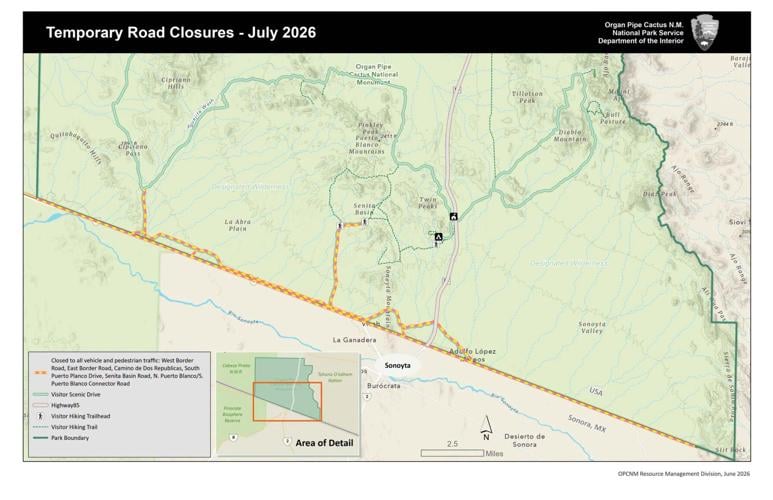
National Park Service officials issued on July 31 for six public roads near the U.S.-Mexico border “in furtherance of the Department of Homeland Security infrastructure project,� according to a notice on Organ Pipe’s website.
The order is “intended to mitigate considerable risk associated with an active, large-scale construction project and applies to all vehicles and pedestrian traffic,� the notice states.
People are also reading…

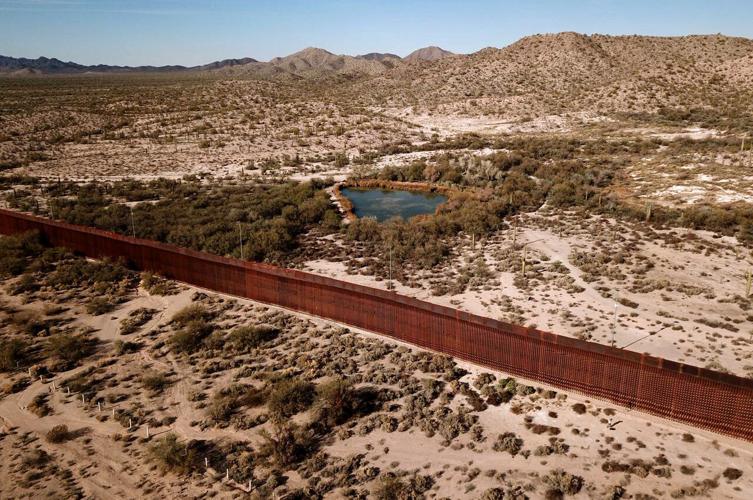
The border wall runs next to Quitobaquito Springs at Organ Pipe Cactus National Monument in an aerial photo taken from Mexico. The Trump administration is planning to build a second wall parallel to the first one, raising concerns about what the project could do to the historic oasis and other sensitive sites.
Monument officials also announced the closures in a that made no mention of border wall construction.

A National Park Service map shows the roads that closed to the public starting July 31 to accommodate border wall construction at Organ Pipe Cactus National Monument.
The closure effectively cuts off access to Quitobaquito Springs, a desert oasis that conservationists fear could be damaged by the Trump administration’s plans to construct a second border wall next to the one it built there in 2020.
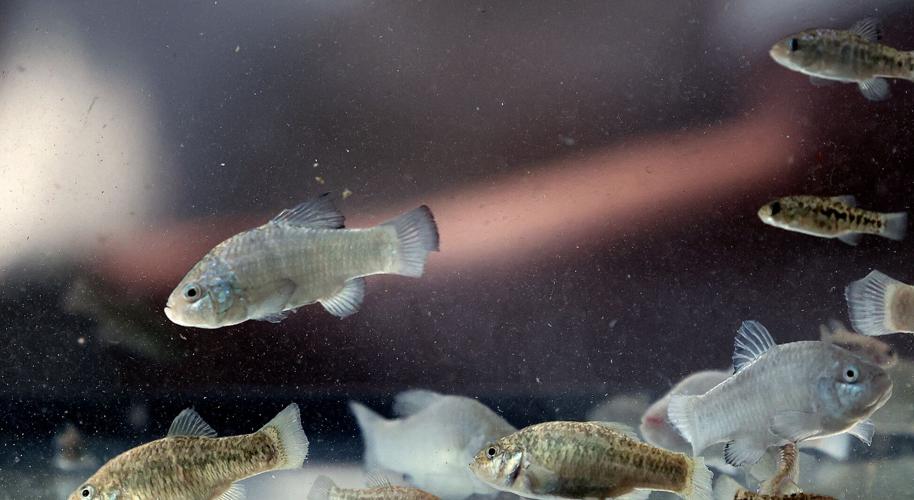
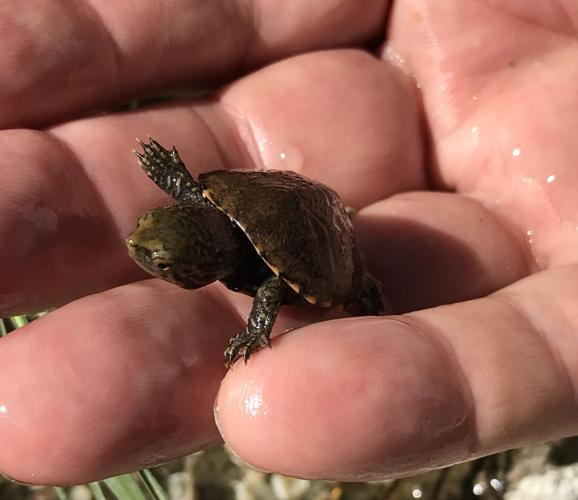
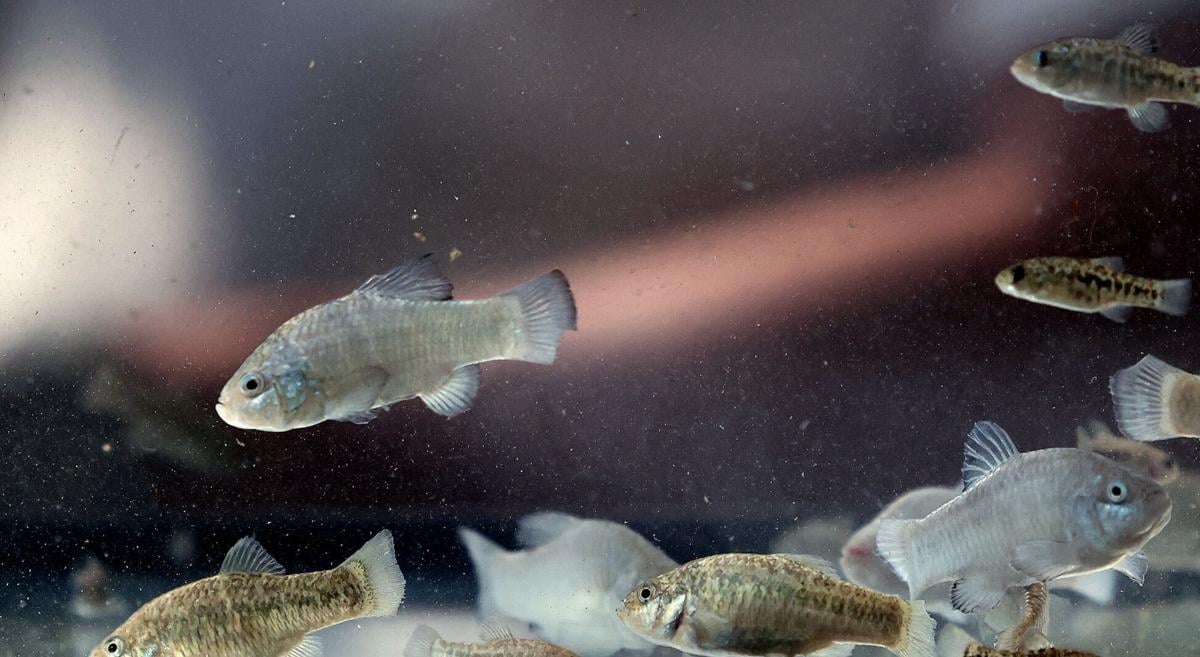
The spring-fed channel and man-made pond at the site represent the last remaining natural habitat in the U.S. for the federally protected Sonoyta mud turtle and Sonoyta pupfish, as well as a tiny springsnail called the Quitobaquito tryonia that could soon join them on the endangered species list.
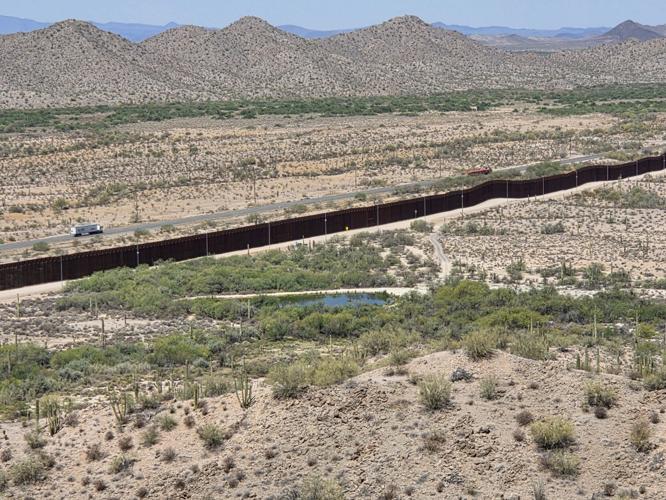
The primary border wall is less than 100 yards from the earthen dam that forms the pond. The planned secondary wall would come even closer to the water.

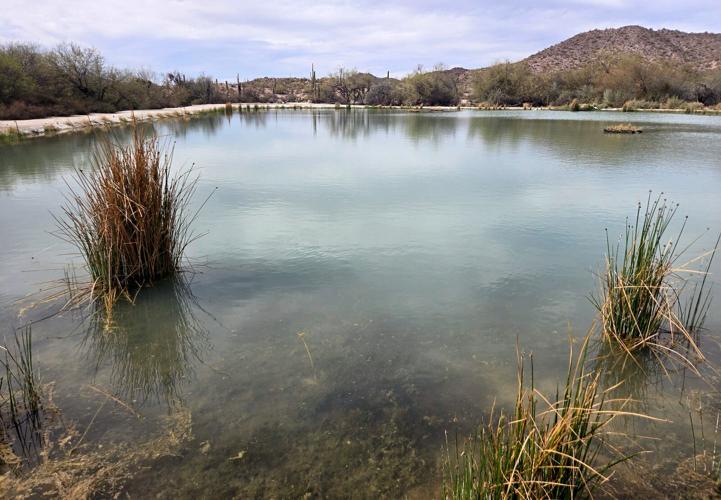
The Quitobaquito Springs pond at Organ Pipe Cactus National Monument.
“The recent road closures at Organ Pipe are alarming, complicating access to Quitobaquito Springs, an important cultural site for the local Indigenous communities who have stewarded this land since time immemorial,� said Sanober Mirza, Arizona program manager for the National Parks Conservation Association, an independent, nonpartisan organization that advocates for Park Service sites. “We believe the National Park Service closed these roads for visitor safety, but let’s be clear that the danger exists because the administration is pushing through construction of a catastrophic second border wall at the monument.�
In late May, U.S. Customs and Border Protection awarded to Tempe-based Sundt Construction to build 13 miles of primary barrier and 45 miles of secondary barrier along the U.S.-Mexico border in western Pima County.
The project is expected to result in two, 30-foot-tall, bollard-style walls running parallel to each other — with an empty "enforcement zone" in between — across all of Organ Pipe and a portion of neighboring Cabeza Prieta National Wildlife Refuge.
The federal contracting website lists Aug. 31, 2028, as the potential completion date for Sundt’s contract.
Doubling down
Double barriers are also planned or already under construction along nearly all of Arizona’s 373-mile boundary with Mexico and could eventually stretch from the Pacific Ocean in California to the Rio Grande in Texas.
DHS has issued a flurry of waivers to expedite the work by exempting it from dozens of federal laws designed to protect wildlife, cultural and historic resources and the environment.

A researcher holds a juvenile endangered Sonoyta mud turtle during a scientific survey at Quitobaquito Springs in southwestern Pima County in 2019.
Organ Pipe officials could not be reached for comment.
Sundt Construction referred all questions about its contract to Customs and Border Protection, which did not respond to the Star’s inquiry by press time.
During a committee hearing in the House in May, U.S. Rep. Adelita Grijalva questioned Interior Secretary Doug Burgum about protections for Quitobaquito Springs. Since then, the Democratic congresswoman from Tucson has not been consulted by the administration about Quitobaquito or shown any plans for what might be built there, a spokesman for her office said.
“DHS and its contractors have shown that they cannot simply be trusted to avoid environmentally sensitive and culturally significant areas, or to respect tribal sovereignty,� said Grijalva in a written statement to the Star. “Ultimately, the public and the media are the last layer of accountability, which is why it is so concerning that neither may be able to monitor construction to ensure Quitobaquito Springs is not disturbed.�
According to the notice on Organ Pipe’s website, the road closures will remain in effect until further notice.
Cottonwood conflict
The move comes as activists at another border-wall construction site in Arizona’s San Rafael Valley, about 20 miles east of Nogales, continue their lofty demonstration aimed at saving the last of four large Fremont cottonwood trees marked for destruction by federal contractors.
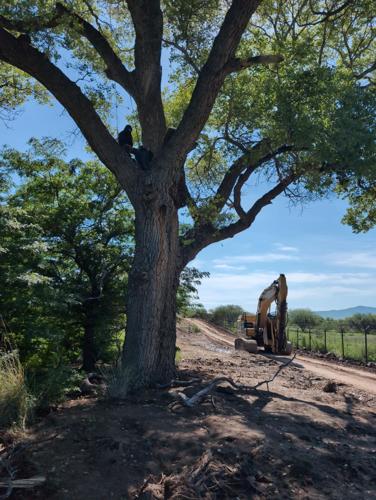
A handful of protestors have been taking turns sitting in the branches of the tree, about 60 feet above the ground, around the clock for nearly two weeks now.

A protestor sits in a cottonwood tree to try to save it from destruction by federal contractors building a new double barrier along the U.S.-Mexico border in the San Rafael Valley near Lochiel.
“They’re holding the tree down so Border Patrol doesn’t take the tree down,� said Erick Meza, the borderlands coordinator for the Sierra Club, who is also serving as spokesman for the tree-sitting volunteers.
He said the group hopes to “give a voice to the tree,� which they have taken to calling the “grandmother cottonwood.�
“They’re all grandmothers; this is just the only one left,� Meza said.
The four towering trees in the near-ghost town of Lochiel were located within the so-called Roosevelt Reservation, a 60-foot-wide strip of land along the border that is owned by the federal government.
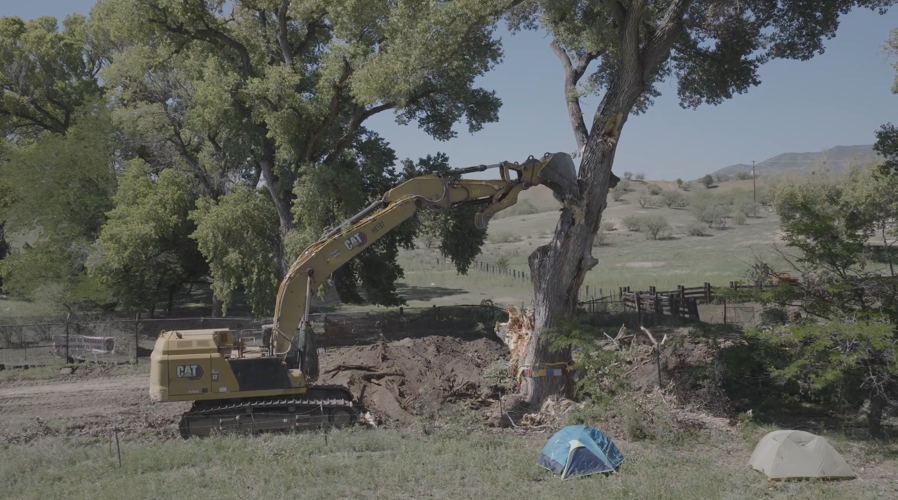
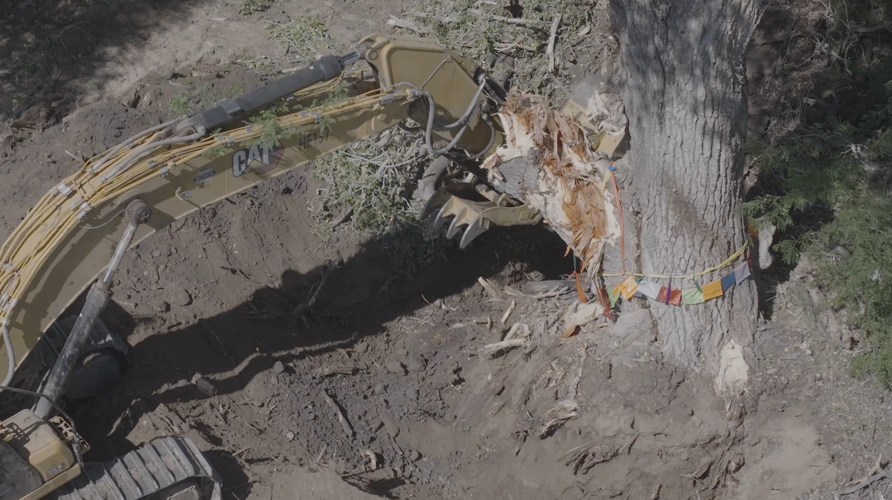
Workers brought in by North Dakota-based border wall contractor Fisher Sand and Gravel began taking down the cottonwoods about two weeks ago. Videos from the site show an excavator digging up the roots of one of the trees, then pushing it over with multicolored prayer flags still wrapped around its trunk.

Workers brought in by a border wall contractor began taking down four towering cottonwoods near Lochiel in the San Rafael Valley about two weeks ago.
By some estimates, Meza said, the trees had been growing there for 150 to 200 years or longer. “They may be as old as this country,� he said.
One of the protesters tried to block the heavy equipment, only to be arrested by local authorities. Santa Cruz County Undersheriff Jerry Castillo said the man, identified as Logan James Miller, 38, of Tucson, was booked in Nogales on July 27 on suspicion of criminal trespassing and later released on his own recognizance.
Billions for barriers
Meza said activists have been camped among the cottonwoods off and on since June, when CBP confirmed in a letter to the Sierra Club that the trees would be cut down to make way for the border wall.
In the same letter, officials committed to providing environmental monitors to check the four trees for active migratory bird nests prior to removal, but drone footage Meza captured the day before demolition began clearly shows a nesting Cassin’s kingbird in one of them.
Grijalva condemned the decision to cut down the cottonwoods.
"The Trump administration is bulldozing our public lands, destroying century-old trees, and endangering wildlife — all to build an unnecessary second border wall. That's not border security; it's reckless destruction,� the congresswoman said. “Arizonans deserve better than an administration that treats our natural landscapes and border communities as collateral damage for a political stunt.�

Border-wall contractors use heavy equipment to take down a Fremont cottonwood tree in the San Rafael Valley near Lochiel.
Meza said ongoing wall construction in the San Rafael Valley also poses a threat to historic buildings and gravesites in Lochiel, just as it does to Indigenous cultural sites, wildlife corridors and unspoiled natural areas across Arizona’s southern boundary.
“All of the laws that apply everywhere else in the country don’t apply here at the border,� he said. “People in the community are sick and tired of seeing so much destruction in the whole borderlands region.�
The tree-sitters have been helped in recent days by monsoon rains that stalled some of the work in the area, Meza said. “The heavy machinery gets stuck in the mud.�
As of Friday afternoon, the demonstration was still ongoing, even with construction activity closing in on the cottonwood from both sides.
Meza couldn’t say how long the protesters will be able to hold out, only that “we’re going to do our best.�

The view from a nearby hilltop shows Quitobaquito Springs, with the border wall and Mexico’s Highway 2 just south of it. Wildlife officials fear a planned secondary border barrier could damage or destroy the spring-fed oasis, which provides the only habitat in the U.S. for three rare animal species.
Last year, the Republican-led Congress handed CBP $46.6 billion so President Donald Trump can double down on his promised border wall.
The wall work in Lochiel is part of a $1.5 billion contract CBP awarded in December to Fisher Sand and Gravel to build 21 miles of primary barrier and 91 miles of secondary barrier from west of Sasabe to Coronado National Memorial south of Sierra Vista.
CBP’s online shows the same company won another bid in May for 66 miles of secondary barrier from Coronado National Memorial east to the New Mexico state line.
Since 2023, Fisher has landed almost $14 billion in border wall construction projects.
CBP’s latest major award in Arizona went to SLSCO LTD to build 62 miles of border wall across the Tohono O’odham Nation. The contract was granted on June 26, 10 days after to stop the project.



 Rescue plan in works for tiny endangered turtle in path of second Arizona border wall