Michael Donnelly is used to speaking to the public through his judicial opinions.
No more, the former Ohio Supreme Court justice said.

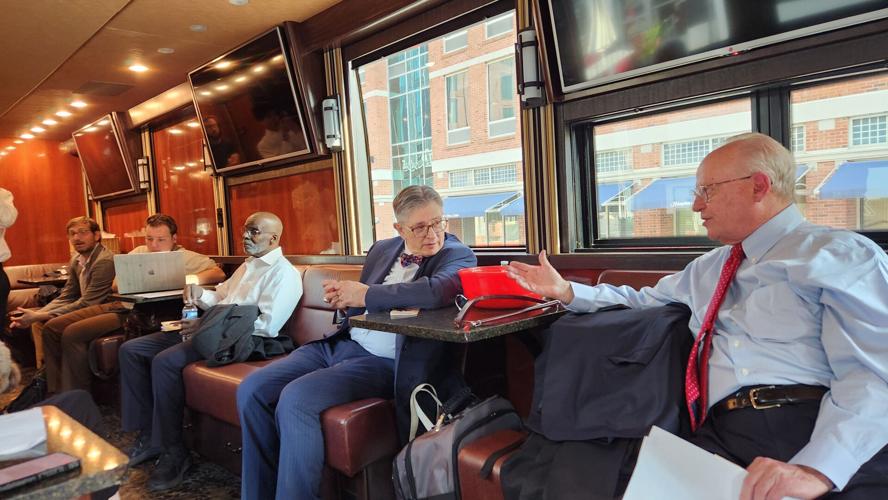
United States Court of International Trade Senior Judge Leo Gordon and former North Carolina Supreme Court Justice Robert Orr talk between stops on the Justice in Motion tour.
So Donnelly, along with a bipartisan group of sitting and retired state and federal judges, did what their profession trains them not to do: speak out in public about what is happening to the courts.
"It's not something I'm comfortable about. During my 20 years on the bench, I never went out and spoke about my opinions. I just let our opinions speak for themselves," Donnelly said. "But these are not normal times, and when you see the politicization of the judiciary taking place and at the speed in which it is ... I have no other choice than to get out and speak out about it."
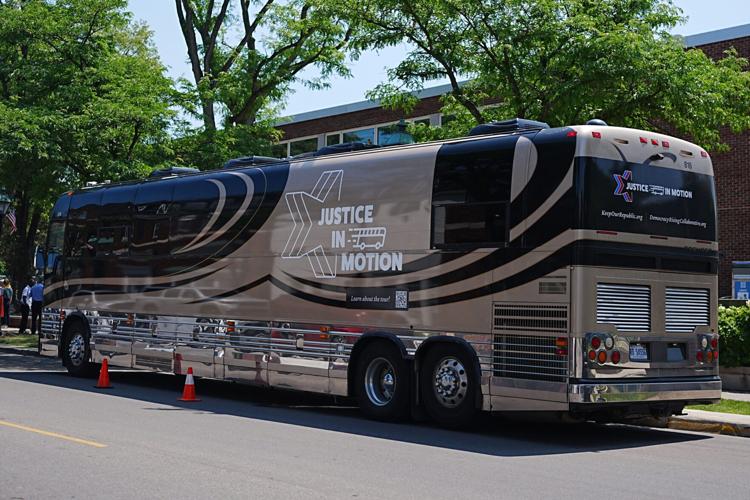
Traveling by bus over four days recently, the group made a dozen stops across Pennsylvania, Ohio and Michigan, speaking with elementary and high school students, lawyers, activists and concerned citizens about the importance of an independent judiciary and the rule of law. Funded by nonpartisan pro-civic engagement groups — Democracy Rising Collaborative and Keep Our Republic — the trip served as a test case for whether Americans are concerned about challenges to the judicial branch's powers.
People are also reading…
The once-quiet judges see a growing threat in a president who personally attacks jurists ruling against him. President Donald Trump has called Supreme Court Justices he appointed "disloyal" and "unpatriotic" for not backing him. Meanwhile, members of Congress are increasingly accusing judges of making political rulings, and threatening to remove those who don't issue decisions they like.

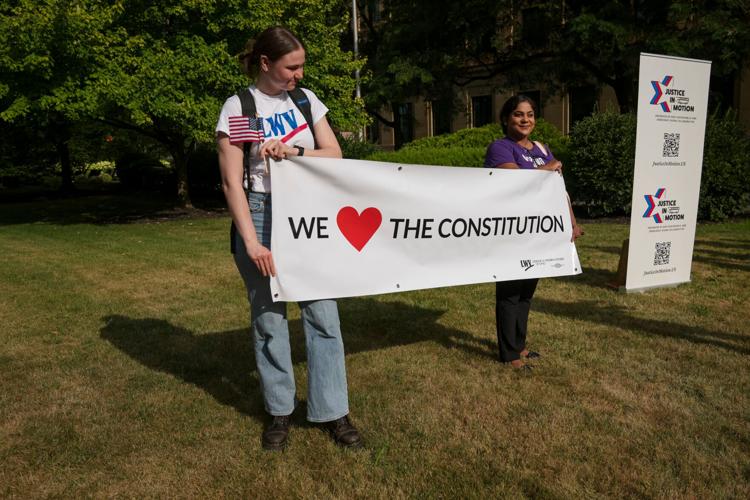
Ohio League of Women Voters members Ava Brady, left, and Munia Mostafa hold a sign during the Justice In Motion bus tour stop in Columbus, Ohio, on July 8.
In March, Supreme Court Chief Justice John Roberts warned in a rare rebuke that personal criticism of federal judges is dangerous. It came two days after Trump called a federal district court judge who ruled against the administration “wacky, nasty, crooked and totally out of control.�
“Personally directed hostility is dangerous,� Roberts said, “and it’s got to stop.�
Roberts didn’t single out Trump, insisting the attacks on judges are not from “just any one political perspective.�
USA Today, which had an exclusive seat on the wood-paneled bus, spoke with the judges about the role Americans will play in the future of their democracy — and why they think now is the time to speak out.

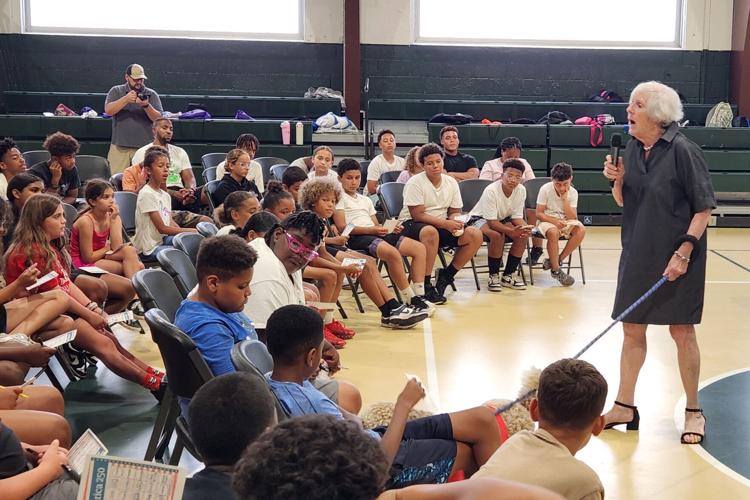
Former Ohio Supreme Court Chief Justice Maureen O'Connor speaks with students during the Justice in Motion bus tour.
Former Ohio Supreme Court Chief Justice Maureen O'Connor fears what could happen if Americans lose faith that the courts will apply the law without regard to politics, party or social standing. A place to start, she said, is making sure people know their local judges and what their job is.
'Democracy defenders'
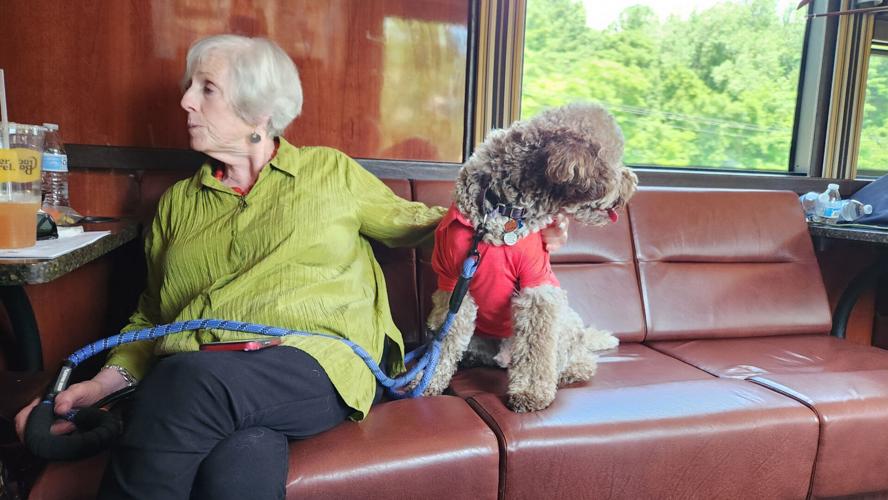
O'Connor's Lagotto Romagnolo puppy, Carlo, spent much of the trip by her side. At the Westmoreland County Courthouse in Greenburg, Pennsylvania, security officers allowed Carlo in when O'Connor said he is a “democracy defender.�
Back on the bus, Carlo lay on the faux leather benches, watching the FIFA World Cup and black-and-white cowboy movies. Former North Carolina Supreme Court Associate Justice Robert Orr slipped him a dog treat from his pocket.

A crowd of people gathers at an event in Wooster, Ohio, during the Justice in Motion bus tour.
At the LeMoyne Community Center in Washington, Pennsylvania, kids questioned the judges about their jobs and role in democracy. There are some people who don't like democracy and want political courts, O'Connor told them.
"Judges have to ignore what the politicians do and say," O'Connor said.
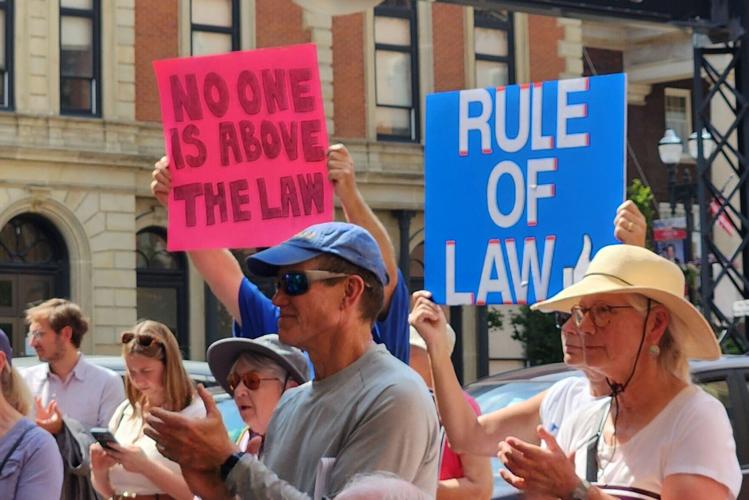
Later, about 100 people waved signs and little American flags outside the Joseph P. Kinneary U.S. Courthouse in Columbus, Ohio, for a press conference with judges, lawyers and civic leaders. The crowd was full of people from the nonpartisan government watchdog group Common Cause, the Ohio State Bar Association and the League of Women Voters.
Anne Hoke, 75, of Columbus, held a sign saying “Protect Our Rights."
“You want to make sure that people who are enforcing the law are going to be fair and honest and aren’t just going to be going after enemies of different politicians,� Hoke said.

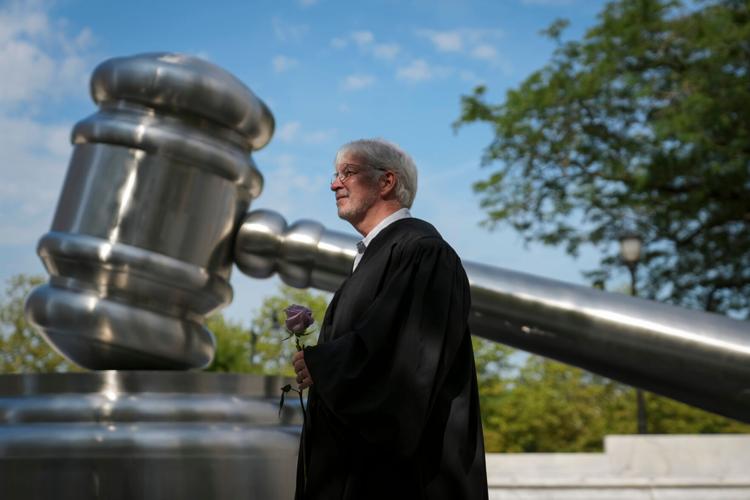
As part of the Justice In Motion bus tour from Pennsylvania to Michigan, former Ohio Supreme Court Justice Michael Donnelly gathers with fellow judges outside the Ohio Supreme Court building in Columbus, Ohio, on July 8. The civic engagement tour is promoting a constitutional government to ensure equal justice under the law and public trust in the judicial system.
Inspired by Poland's 2020 "March of a Thousand Robes" campaign for defending judicial independence, the judges slipped on their robes and walked several blocks with the crowd to the Ohio Supreme Court Plaza. They held purple roses, symbolizing judicial independence.
“I’m here because we have to do something, we have to make sure that judges speak, that we are showing that we are not partisan and try to continue to emphasize to the remainder of society and our citizens (that) degrading the judiciary is wrong,� said Judge Michael Mentel, who serves on Ohio's Tenth District Court of Appeals.
Retired Cleveland Municipal Court Judge Ron Adrine said the tour had to be bipartisan if he was going to attach his name and reputation to it. He is a Democrat and O'Connor a Republican.
“A lot of judges have been really (careful) about standing up for some of this, for fear that they'll be seen as being partisan one way or another," Adrine said. "There is nothing partisan about it. As a matter of fact, we've really kind of bent over backwards to recruit judges who are bipartisan."
Pocket-sized Constitutions
In Wooster, Ohio, people held handmade signs praising the rule of law and thanking the judges for raising awareness. The League of Women Voters of Wayne County set up a table to register voters. Members of the local bar association joined the crowd. Organizers passed out pocket-sized Constitutions.
“You have to be the voices out there, making people understand that the judges aren’t just the names at the end of the ballot. They are the ones who can make a difference in your lives and in our country’s life and (the) trajectory of our states and our nation,� Judge Betty Sutton, who serves on the Ohio's 9th District Court of Appeals, said to the crowd.

The Justice in Motion tour made its last stop at Grosse Pointe Public Library in Grosse Pointe Farms, Mich., on July 10.
U.S. Court of International Trade Senior Judge Leo Gordon described how the increasing physical attacks on judges have changed their lives and affected their families.
Some in the crowd wanted to talk about money in politics, the Supreme Court's most recent decisions and voter ID legislation.
“I see the courts as the guardrails for processes and policies and actions all across the board,� said Barb Friedhoff, 66, of Wooster. “We’re seeing those guardrails being, not taken down, but slowly eroding.�
Donnelly told the crowd the founders understood human nature and power when they created three equal branches of government. Citizens need to guard against efforts to diminish the power and authority of the judicial branch, he said.
“The Constitution will not defend itself. It never has, it never will. The rule of law will not defend itself. It never has, it never will,� he said. “Democracy will not defend itself. It never has, it never will.�
He added: “The threat to the rule of law is greater than at any point in my lifetime.�
Back on the bus, the judges marveled at the crowd size, questioning if they should focus on more small towns.

Former Ohio Supreme Court Chief Justice Maureen O'Connor and Carlo the dog on the Justice in Motion bus on July 8.
“We need to humanize the institution," Orr said. "These are not some hidden-away figures making rulings that affect people's lives. These are women and men who are from our communities (and) who, for the most part, had long careers in the law or the judiciary, and the vast majority are trying to do the right thing."
Adopt a judge
High school students peppered the judges inside the Carl B. Stokes U.S. Courthouse in Cleveland. How does artificial intelligence change their job? How do they ensure diverse opinions among their clerks? Why can sentences differ so much between judges?
Gordon told the kids he writes opinions so carefully that sometimes he and clerks spend 15 minutes searching for the correct word.
During a barbecue lunch at the ThirdSpace Action Lab, judges were "adopted" by students and community members. Gordon described the lengthy process of being interviewed and selected to be appointed to a federal judgeship. It can be misleading, he said, when the news media identifies which presidents appointed judges. For example, Gordon is a Democrat who was selected for his judgeship by President George W. Bush.
The judges' trip ended July 10 at the Grosse Pointe Public Library near Detroit, where some talked about the threats their families have faced.
Michigan 2nd District Court of Appeals Judge Chris Trebilcock said after he was appointed he warned his children about posting to social media or opening the door to strangers.
"All of us are people with families... we're also members of your community," he said.
Several of the judges said they hope the tour will be duplicated nationwide.
Adrine said it was important to kick-start the idea that judges should stand up for their profession.
"I'm hopeful that other people will be inspired to do things similar to this," Adrine said. "A march of a thousand judges takes a single judge to start."