ANCHORAGE, Alaska — The life of one of the most remote grizzly bear populations in the world is being documented by the animals themselves, with collar cameras that provide a rare glimpse of how they survive on Alaska’s rugged and desolate North Slope.
Twelve of the 200 or so grizzlies that roam the frigid, treeless terrain near the Arctic Ocean were outfitted with the cameras as part of a research project by Washington State University and the Alaska Department of Fish and Game.

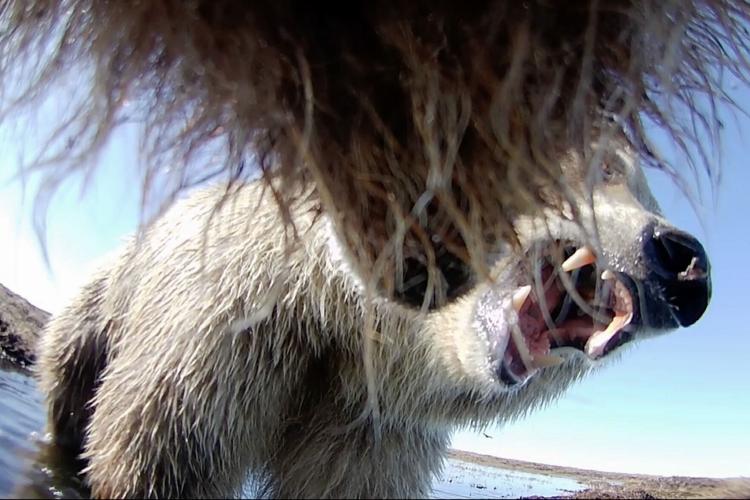
This undated image from January 2026, made from a video taken from a grizzly bear's collar camera, shows two grizzly bears playing on the tundra in Alaska's North Slope.
The videos they record — many partially obscured by the undersides of whiskery muzzles — show the bears playing or fighting with companions, gnawing on a caribou, snarfing up berries, napping on a beach, and swimming in a pond looking for fish.
The bears hibernate about eight months of the year.
“They really have a really short window to obtain enough food resources to pack on enough fat to survive that period,� said Washington State doctoral student Ellery Vincent, who is leading the project with state wildlife biologist Jordan Pruszenski.
People are also reading…

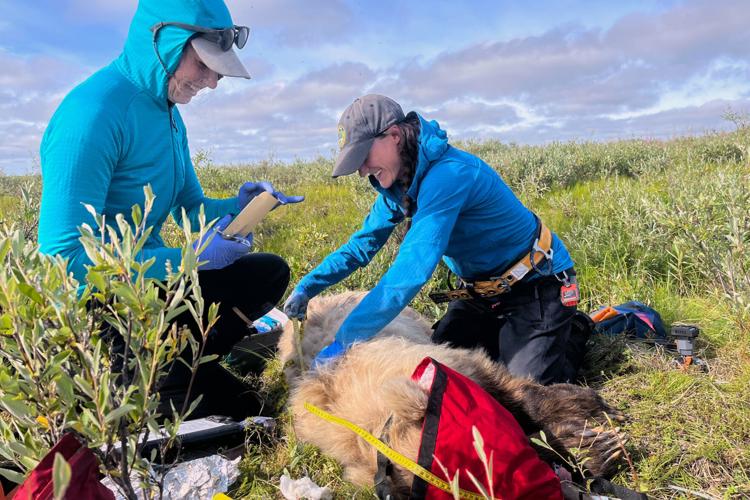
This Aug. 5, 2025, photo shows Washington State University doctoral student Ellery Vincent, left, and Alaska Department of Fish and Game Wildlife Biologist Jordan Pruszenski taking measurements and samples of an anesthetized grizzly bear prior to affixing a video collar on it in the North Slope of Alaska.
“We’re interested in looking at kind of a broad scale of how they’re obtaining the food that allows them to survive through the year and what exactly they’re choosing to eat,� Vincent said.
Among other things, the state is interested in learning to what extent the bears hunt musk oxen. There are about 300 of the shaggy ice-age survivors on the North Slope, according to Pruszenski, but the population is not flourishing.
Videos from the first year of the project show that after emerging from hibernation, the bears eat the carcasses of caribou or musk ox that died over the winter. Then they attack caribou calves. As soon as the tundra greens up, the bears shift their menu toward vegetation, especially blueberries and soapberries, also called buffaloberries.
They don't fatten up the way salmon-eating bears do. Those bears can reach up to 1,000 pounds. These Arctic grizzlies are small in comparison, reaching up to 350 pounds, Vincent said.

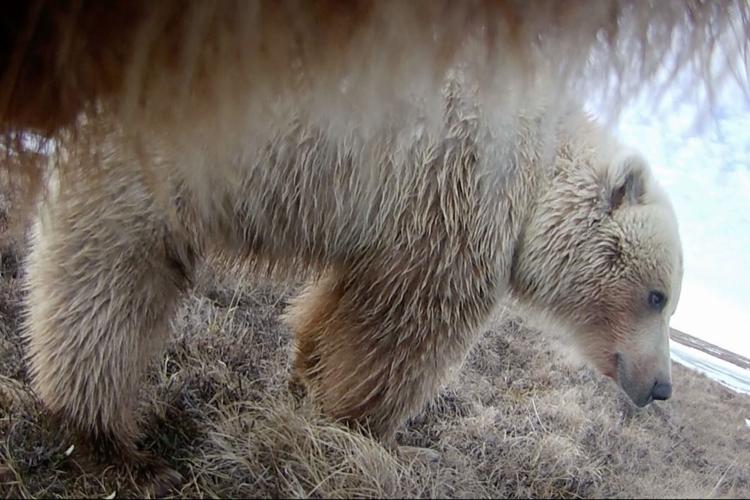
This undated image from January 2026, made from a video taken by a grizzly bear's collar camera, shows another grizzly bear on the tundra of Alaska's North Slope.
To initially fit the bears with the collar cams, the researchers tracked them through the snow by helicopter last May. Pruszenski fired tranquilizer darts from the air, with Vincent keeping track of injection times and helping determine when the bear was safe to approach on the ground.
They placed the collars on the bears, keeping them loose enough that the bears could grow into them as they put on weight, but not so loose that they would fall off as the bears go about their rough-and-tumble lives.
“It is not difficult, but there is a lot of thought that goes into making sure the collar is adjusted properly,� Vincent said.
The researchers darted the bears again in August to replace the collars and in September to download data. The researchers also measured the bears’ weight gain and body fat.
When those collars came off, the state wildlife department replaced them with GPS collars.
That data could determine how oil-field development is impacting bears and help identify where they den during the winter, areas that oil companies must avoid when they build winter roads between drill sites.
The cameras can record up to 17 hours of video. In the spring and summer, they took a short video clip — four to six seconds — every 10 minutes. In the fall, due to the encroaching darkness, they recorded clips every five minutes during daylight.
Despite their brevity, the clips provide a rare perspective of how the bears thrive on the desolate North Slope, an area that covers about 94,000 square miles but is home to only about 11,000 people. Nearly half of the residents live in Utqiagvik, the nation’s most northern community, formerly known as Barrow.
“One thing that’s really nice about these bears is that when they’re foraging on a particular food they tend to do that one thing for a long period of time, so these bears will spend pretty much their entire day eating, so the chances of us actually seeing what they’re doing are pretty high,� Vincent said.

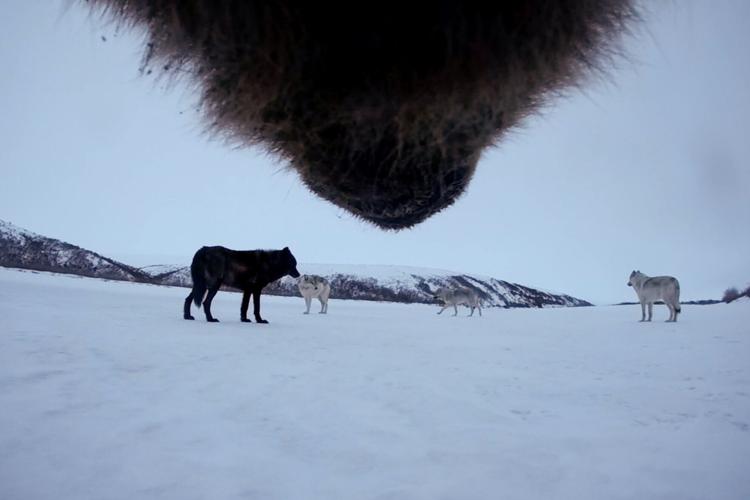
This undated image from January 2026, made from a video taken from a grizzly bear's collar camera, shows the bear encountering a wolf pack on the snow-covered tundra of Alaska's North Slope.
The cameras also caught an encounter between a bear and pack of wolves.
It occurred after the bear emerged from hibernation in May. He was not eating yet, so there was no adverse interaction with the wolves over food, she said. There were no wolves visible in the next clip, indicating it was a peaceful exchange.
“I think they both decided that it wasn’t worth it, so they just looked at each other, then moved on,� Vincent said.
The study will continue for two more years, with plans to add collars to 24 more bears.
Fragile, fierce and fleeting: AP’s best animal and nature photos of 2025

A newborn chick looks out of the feathers of its mother at a farm in Wehrheim near Frankfurt, Germany, July 14, 2025. (AP Photo/Michael Probst, File)

A raccoon eats peanuts on the boardwalk in Panama City, March 23, 2025. (AP Photo/Matias Delacroix, File)

A Drosera capensis plant traps an insect at a carnivorous plant exhibit at the Botanical Garden in Bogota, Colombia, April 3, 2025. (AP Photo/Fernando Vergara, File)

A stag is silhouetted as it walks through a forest in the Taunus region near Frankfurt, Germany, Oct. 1, 2025. (AP Photo/Michael Probst, File)

Sandhill cranes are seen at the Wheeler National Wildlife Refuge, Jan. 13, 2025, in Decatur, Ala. (AP Photo/George Walker IV, File)

An albino turtle hatchling sits among other Arrau turtles (podocnemis expansa) ahead of their release at the Abufari Biological Reserve, in Tapaua, Amazonas state, Brazil, Nov. 17, 2025. (AP Photo/Edmar Barros, File)

A Monitor Lizard rests on a tree inside the Kaziranga National Park in Kaziranga, India, March 4, 2025. (AP Photo/Anupam Nath, File)

A stork couple is backdropped by the rising sun after a night of minus seven degrees Celsius (19.4 Fahrenheit) weather, on a field in Wehrheim near Frankfurt, Germany, Feb. 19, 2025. (AP Photo/Michael Probst, File)

A herd of sheep is guided through central Madrid, Spain, as shepherds lead them through the streets in defense of ancient grazing and migration rights, Oct. 19, 2025, in Madrid, Spain. (AP Photo/Manu Fernandez, File)

Brown marmorated stink bugs sit on a dandelion flower at a park in Tallinn, Estonia, May 25, 2025. (AP Photo/Sergei Grits, File)

A peacock alights next to a pickup truck at Mack's Fish Camp, a family-owned airboat tour business and campground on the Eastern edge of the Everglades, May 28, 2025, near Miramar, Fla. (AP Photo/Rebecca Blackwell, File)

Butterflies gather around flowers along the Riverwalk, July 18, 2025, in San Antonio. (AP Photo/Eric Gay, File)

A ladybug sits on a dandelion flower at a park in Tallinn, Estonia, May 25, 2025. (AP Photo/Sergei Grits, File)

A female African elephant named Pupy stands in her enclosure at the Ecoparque in Buenos Aires, Argentina, March 25, 2025, as she is trained for her relocation to a sanctuary in Brazil. (AP Photo/Natacha Pisarenko, File)

A golden snub-nosed monkey is seen in Shennongjia National Park in central China's Hubei province, June 18, 2025. (AP Photo/Ng Han Guan, File)

Mute swans float on the River Thames, Oct. 10, 2025, in Windsor, England. (AP Photo/Julia Demaree Nikhinson, File)

A humpback whale breaches off the coast of Port Stephens north of Sydney, Australia, June 18, 2025. (AP Photo/Mark Baker, File)

Migrating cranes flock at sunrise in Hula Lake conservation area, north of the Sea of Galilee, northern Israel, Jan. 23, 2025. (AP Photo/Ariel Schalit, File)

A frog swims in a pond behind the Bellevue Palace in Berlin, Germany, May 12, 2025. (AP Photo/Markus Schreiber, File)

Vultures fly over the decomposed body of an animal, unseen, in Jammu, India, May 27, 2025. (AP Photo/Channi Anand, File)

The veins of an adult periodical cicada's translucent wings are illuminated shortly after shedding its nymphal skin after a heavy rain, May 16, 2025, in Cincinnati. (AP Photo/Carolyn Kaster, File)

A young wild horse stands by its mother in a meadow near the city of Duelmen, Germany, where the herd lives in almost unmanaged feral conditions, April 19, 2025. (AP Photo/Martin Meissner, File)

Storks fly over fields in Buettelborn near Frankfurt, Germany, Sept. 23, 2025. (AP Photo/Michael Probst, File)

A polar bear is seen in front of an abandoned research station on Koluchin Island, off Chukotka, Russia, in the country's Far East, Sept. 14, 2025. (AP Photo/Vadim Makhorov, File)

A hummingbird drinks from a flower in a garden on the outfield lawn before a spring training baseball game between the Kansas City Royals and the Athletics, Feb. 24, 2025, in Surprise, Ariz. (AP Photo/Lindsey Wasson, File)

A bee collects pollen from a blue salvia, part of the blue, green, and white flower color scheme at the All England Lawn Tennis and Croquet Club, ahead of the Wimbledon Championships in London, June 25, 2025. (AP Photo/Kirsty Wigglesworth, File)

A grey squirrel jumps amongst autumn leaves in a London park, Nov. 4, 2025. (AP Photo/Kin Cheung, File)

An adult periodical cicada, in the process of shedding its nymphal skin, is seen on May 20, 2025, in Cincinnati. (AP Photo/Carolyn Kaster, File)

A couple of White-tailed eagles fight while hunting at the Bosfor Vostochny channel in Vladivostok, Russia, Feb. 10, 2025. (AP Photo/Anton Balashov, File)