

Proposed legislation would make Arizona the only state in the nation without maximum speed limits on some highways.
Rep. Nick Kupper wants speed limits to be at least 80 miles per hour in rural areas, five miles faster than the highest limits now on any Arizona highway. But under his proposal, motorists legally could drive faster — much faster.
His House Bill 2059Â would allow the Arizona Department of Transportation director to entirely deregulate rural stretches of highway so there would be no posted limit at all during daylight hours for non-commercial traffic.
Kupper argues that removing posted limits is not unsafe. In an effort to prove that point, his proposal would mandate a pilot project designating a stretch of Interstate 8 between Casa Grande and Yuma as a "derestricted speed zone'' for at least a year to see whether it affected crash rates.
People are also reading…
That would be during daylight hours, and only for noncommercial vehicles. Trucks, buses and trailers would be limited to 80, which would also be the top speed for everyone at night.
Then, as Kupper sees it, ADOT would use that information to decide whether, first, to keep that designation in place on I-8 and, later, to expand deregulated speeds on other interstate highways in non-urbanized areas, defined as any stretch where there are 50,000 or fewer residents.
That could mean deregulating speed limits along large expanses of Interstates 10, 17, 19 and 40, along with a segment of I-15 that runs through the northwest corner of Arizona.
"I fully appreciate the fact that, naturally, your first inclination is: that's craziness, you're going to kill people,'' said Kupper, a Republican from Surprise.
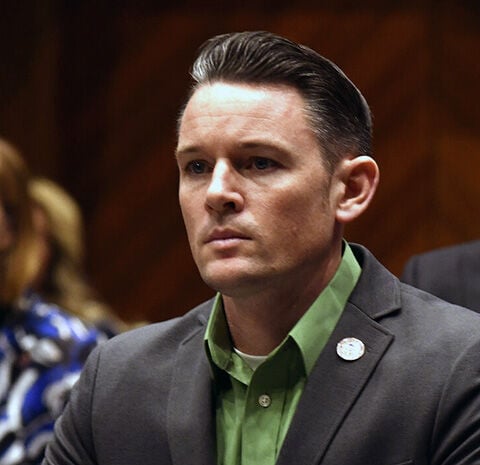
Rep. Nick Kupper
"However, the data proves otherwise,'' he continued. "And I want to do this pilot program to prove that we can actually do this and save lives.''
Kupper cited research from Montana, where he said higher limits resulted in more motorists driving similar speed limits, actually resulting in fewer accidents.
That is backed by a report by the Montana Department of Transportation which, looking at other studies, said crash severity "may increase because of variances in speed and not because of higher speeds,'' though that study also included not just divided access highways but also two-lane roads.
"It's kind of an interesting psychological phenomenon where when you don't have a set speed limit, people tend to coalesce around a certain speed,'' Kupper said.
Overall speeds went up about 5 miles per hour in Montana's experience, he acknowledged.Â
"However, what was really interesting, was that the fastest person and the slowest person tended to be closer in speed to each other than when you have a set speed limit,'' Kupper said. "And when you have less of a variance, you have fewer accidents and fewer fatalities.''
There is some local evidence to back up that contention.
In 2023, ADOT boosted the speed limit on a stretch of I-17 from 55 mph to 65, saying the higher limit "can result in more drivers traveling closer to the same speed, which enhances safety.''
ADOT made the same comment last week when it raised the speed limit on a four-lane stretch of State Route 24 in southeast Maricopa County from 45 to 55 miles per hour.
Kupper said if police aren't focused on speed they can pay more attention to other issues, such as drivers using a phone or not wearing a seat belt, "things that will get you killed.''
He said he understands there will be some who will insist that higher speeds will lead to more dead motorists.
"Naturally, it feels wrong. And people go by feelings. I get it," he said, but added, "They don't have any data to prove me wrong."
But the Insurance Institute of Highway Safety says it does have the data to contradict Kupper's claims.Â
"Research has found that higher speed limits are associated with more crash fatalities,'' said Joseph Young, the organization's director of media relations.
"A study of 25 years of speed limit increases across the country found that raising the state speed limit by 5 mph results in about an 8% increase in fatality rates on those roads with the highest speed limits, like interstates,''Â Young said.
Overall, he said, over that 25 years about 37,000 deaths could be attributed to a speed limit increase.
Kupper said that shouldn't affect his proposal to scrap the current 75 mph speed limits on rural interstates.
"People are going 10 to 15 over already,'' he said.
He said that's why he chose Interstate 8 as his one-year test area.
"They're traveling faster than that right now, 85 to 90 as it is,'' Kupper said, noting the interstate there has long straight stretches and few entrances and exits. "The data that I've been able to pull shows that, per vehicle mile traveled, it is the safest interstate we have.''
Anyway, he said, even if the limits are lifted, that won't be the end of the discussion.
"If the data comes back and the ADOT director says, 'It's more dangerous,' we don't do it anymore, it's over,'' Kupper said.
"It gives them the authority after a year to continue on,'' he said. "Or, I guess, if we at the Legislature decide to do something different with it, we could.''
His bill still would require people to drive at a speed that is "reasonable and prudent.'' Specifically, that would be defined defined for any derestricted stretches as speed that is excessive given road and weather conditions, traffic volume, visibility, the vehicle's mechanical condition, and "a driver's reaction time.''
"A driver's reaction time" is about someone following too closely, given the speed they are going, Kupper said.
"Let's say you're going 85 miles per hour and you're 20 feet behind the car in front of you. That is not reasonable,'' Kupper said. "I think everyone could assume that. It's not going to give you the reaction time to put on the brake if something happens.''
Young questioned whether it's safe to simply declare that anything "reasonable and prudent'' is legal.
"It may prove challenging for officers to enforce,'' he said.
Young said if Arizona does boost speed rural interstate speed limits — whether to 80 or by deregulating entirely — the state should be sure there's a clear plan in place to enforce those limits, and not just on the highways.
"Research has shown that higher speed limits can have a spillover effect on nearby roads where there was no intention to change the limit,'' he said.
Howard Fischer is a veteran journalist who has been reporting since 1970 and covering state politics and the Legislature since 1982. Follow him on X,  and Threads at @azcapmedia or email azcapmedia@gmail.com.


