Arizona was the best the Big 12 had to offer last season, and it wasn’t particularly close.
The Wildcats won the regular-season title with room to spare, doubled up with the tournament trophy and were the last team standing in March Madness by two full rounds.
That total dominance leaves us to wonder: Will they repeat the feat in 2026-27?
With 100 days until the regular season begins, coach Tommy Lloyd and Co. appear to possess the best combination of talent, experience, depth and size.
All four elements are required to survive one of the toughest conference races in the country even if the Big 12 doesn't possess as many elite teams as it did last season.
Here’s how we see the race following NBA Draft, transfer portal and high school recruiting decisions.
People are also reading…
(Our April placements are in parentheses)

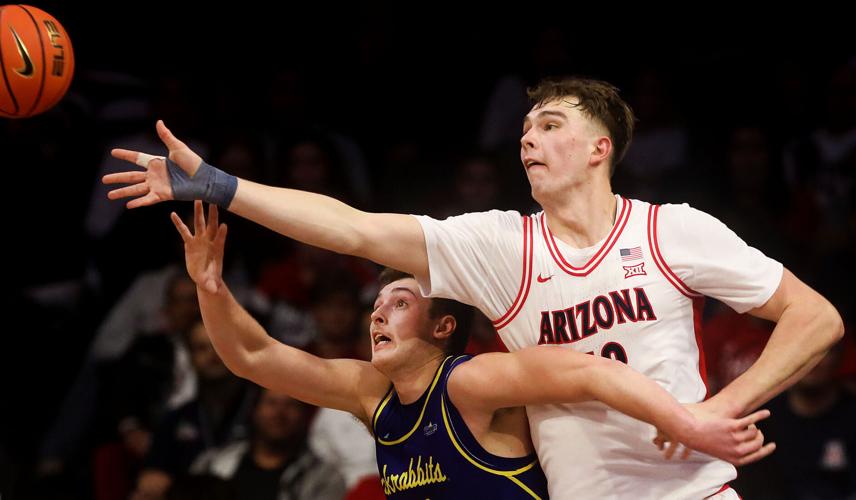
Arizona Wildcats center Motiejus Krivas reaches for the ball over South Dakota State Jackrabbits forward Damon Wilkinson in the first half during a game at McKale Center on Dec. 29, 2025.
1. Arizona
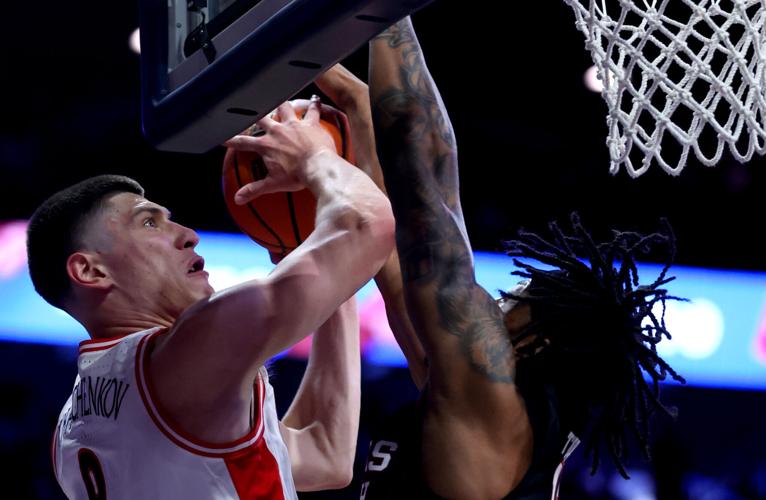
We expect some slippage — as currently constructed, the roster does not suggest another Final Four run is at hand. The Wildcats lost more than they gained, particularly at point guard. There’s plenty to like about transfer Derek Dixon (North Carolina), but can he fully replace Big 12 Player of the Year Jaden Bradley’s leadership and late-game production? We’re skeptical. Arizona should be elite defensively with bruisers Motiejus Krivas and Ivan Kharchenkov up front and freshman wing Caleb Holt, but the playmaking could be lacking without Brayden Burries and Koa Peat. Don’t be surprised if the Wildcats grind their way to another conference title but enter the NCAAs as something less than a No. 1 seed. (Previous: 1)
2. Iowa State
Had Milan Momcilovic returned, the Cyclones would have been our pick to win the conference. But losing Momcilovic and Tamin Lipsey and Joshua Jefferson? That’s a triple whammy even coach TJ Otzelberger cannot offset. The defense and toughness are givens in Ames. And the new perimeter pillars, Killyan Toure and Jamarion Batemon, will prevent a significant backslide, but they will need help for the Cyclones to overtake Arizona. That process begins with Northwestern transfer Trey Singleton. (Previous: 3)
3. Houston
Much like Arizona and Iowa State, the Cougars will be hard-pressed to fully replace what they lost on the perimeter following the departures of Kingston Flemings, Emanuel Sharp and Milos Uzan, who combined for 43 points per game. Transfer Dedan Thomas (LSU) will take charge at point guard, but are wings Mercy Miller and Chase McCarty ready for enhanced roles? We suspect forward Delrecco Gillespie (Kent State) will be one of the Big 12’s best transfers. But for the first time in years — and beyond any specific personnel deficiencies — we are left wondering if the Cougars and coach Kelvin Sampson have lost a bit of their mojo. They look more like a top-25 team than a top-10 dynamo. (Previous: 2)
4. Kansas
The NIL era brought the Jayhawks back to the pack within the Big 12, and there’s little indication that altered state will change after KU lost not only Darryn Peterson but also Bryson Tiller and Flory Bidunga. With one major exception, the Jayhawks have an entirely forgettable roster: Wing Tyran Stokes, the top recruit in the country and a potential No. 1 pick in the NBA Draft. If Stokes handles the pressure of carrying a blue blood and the grind of the Big 12 season, KU should remain relevant. If he falters, this projection could prove overly optimistic. (Previous: 6)
5. TCU
Our first sleeper pick comes with a morsel of trepidation following David Punch's transfer to Texas. (Then again, TCU would not be viewed as a sleeper had Punch stayed.) However, coach Jamie Dixon has enough proven production to contend for the Big 12's top tier if forwards Xavier Edmonds and Micah Robinson emerge as one of the top frontcourt tandems in the conference and Brock Harding offers a steady hand at point guard. The Horned Frogs will make us look shrewd or silly. As we see it, there's zero middle ground. (Previous: 4)
6. West Virginia
Our second sleeper pick is rooted in faith that coach Ross Hodge, who exceeded expectations in his first season (21 wins), will continue the momentum in Morgantown. The Mountaineers landed one of the most coveted big men in the portal, Mouhamed Sylla (Georgia Tech), along with guards Joson Sanon (St. John's) and Finley Bizjack (Butler). In fact, their six-man transfer class ranks second in the conference (behind Arizona State) according to 247Sports. Hodge has more than enough material. (Previous: 8)
7. BYU
Expect a regression in Provo — it’s merely a question of how steep. Without AJ Dybantsa and Richie Saunders, playmaking responsibility falls to point guard Robert Wright. He needs support from ace recruit Bruce Branch and transfer Collin Chandler (Kentucky). But we care less about the talent ceiling and more about BYU mustering the necessary grit. In two years under coach Kevin Young, the Cougars have ranked 82nd and 59th nationally in defensive efficiency (per KenPom). That must improve markedly to offset what BYU lost offensively without Dybantsa and Saunders. (Previous: 5)

Arizona forward Ivan Kharchenkov (8) tries to get his shot off past Texas Tech forward JT Toppin (15) in the first half their Big 12 game, Feb. 14, 2026, in Tucson.
8. Texas Tech
Our assumption is that All-American forward JT Toppin, who tore his ACL late last season, will be approaching top form by March. (Admittedly, that could prove overly optimistic.) But how will the Red Raiders navigate the Big 12 until that point? Doubting coach Grant McCasland is a fool's game, and he has several interesting pieces to assimilate, including transfer Cruz Davis (Hofstra). We are struggling to see how Texas Tech separates from the pack as long as Toppin is less than 100%. (Previous: 7)
9. Arizona State
You can count on one hand the number of coaches who identify and develop talent more effectively than Randy Bennett, and his rebuild in Tempe is progressing at warp speed with a stellar transfer class. Granted, most of the newcomers are moving up in competition from the West Coast Conference, but we saw more than enough from Paulius Murauskas (Saint Mary's) and Emmanuel Innocenti (Gonzaga) to believe they will be effective players in the Big 12. And don't forget: ASU should benefit, at least in 2026-27, from low expectations. There won't be any internal pressure, and opponents won't view the Sun Devils as a threat. (Previous: 11)
10. Oklahoma State
The Cowboys could become a trendy pick to break into the top half of the conference thanks to a heralded transfer class featuring wings Jordan Burks (UCF) and Luka Bogavac, who left North Carolina following the coaching change in Chapel Hill. He possesses the skill set needed to propel Oklahoma State to a competitive level within the conference. Beyond that, the trajectory depends on coach Steve Lutz molding a barrage of newcomers into a cohesive unit by the start of round-robin play. OSU, not West Virginia or TCU, could be the real sleeper. (Previous: 13)

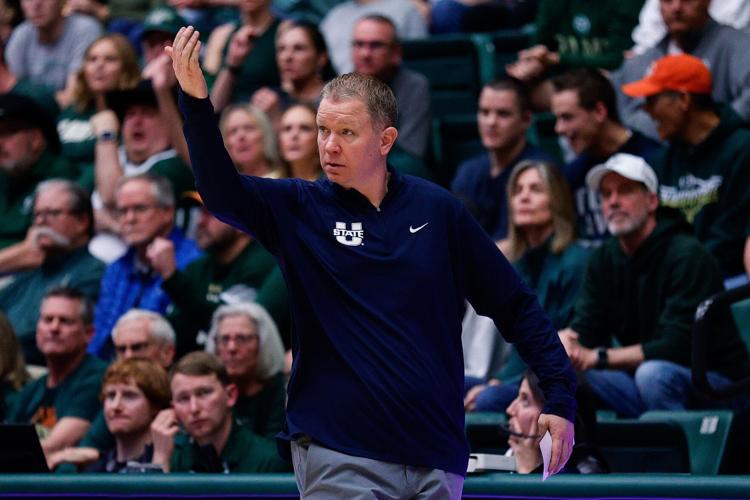
Utah State Aggies head coach Jerrod Calhoun in the second half against the Colorado State Rams at Moby Arena on March 1, 2025, in Fort Collins, Colorado.
11. Cincinnati
Hotline forecasts are wrong more often than they are right. But we’re quite confident that first-year coach Jerrod Calhoun, fresh from a stellar stint at Utah State, will turn Cincinnati into a relevant program. His impressive transfer haul, which includes forward Myles Colvin from Wake Forest, offers early proof of the transformation. The Bearcats were respectable under Wes Miller but will be dangerous under Calhoun, although it might take two seasons. (Previous: 9)
12. Baylor
Five years ago, the Bears were kings of the sport. Today, they are an afterthought in the Big 12, having been lapped by the likes of Texas Tech and Iowa State. There's a chance relevance could return in 2026-27 with the arrival of the Mingo brothers: Kayden, a transfer from Penn State, and Dylan, a five-star prospect who was originally headed to North Carolina. But does Scott Drew, in his third decade as head coach, have the urgency to maximize the considerable talent at his disposal? (Previous: 12)
13. UCF
The Knights are on the short list of teams that were hit hardest by attrition but lacked the NIL resources to adequately backfill from the transfer portal. As a result, we envision a steep regression in Orlando. Coach Johnny Dawkins and Co. have lost ground relative to peers like Cincinnati, Oklahoma State and West Virginia. It's difficult to spot a path back to the middle of the conference. (Previous: 10)
14. Kansas State
Casey Alexander won in the Atlantic Sun, Ohio Valley and Missouri Valley and will thrive eventually in the Big 12, too. But the process will take several recruiting cycles. The first-year coach's first order of business is molding a starting five composed entirely of transfers. (PJ Haggerty’s departure might not be as significant as the loss of 23 points per game appears.) Could the Wildcats climb into the top half? Stranger things have happened in the Big 12. (Previous: 15)
15. Utah
Trajectories change quickly in this era of freewheeling roster construction, and Utah offers a terrific example: In late June, the Utes signed guard Noam Yaacov, a coveted international prospect from Israel. If he elevates the surrounding talent, Utah could claw its way out of the Big 12's bottom tier and provide Alex Jensen's tenure with needed momentum. Until we see proof, however, the outlook remains dim. (Previous: 16)
16. Colorado
Like the team listed immediately above, the Buffaloes do not appear equipped to thrive in the Big 12 basketball ecosystem. They simply lack the NIL funding necessary to compile a top-tier roster on a regular basis. (Losing guard Isaiah Johnson to Texas was merely the latest blow.) Tad Boyle is a quality coach in a brutal spot, and this might be the least talented roster of his long tenure in Boulder. (Previous: 14)