The Arizona Wildcats finally wore pants.
The UA football team donned full uniforms for its last dress rehearsal before training camp — the Spring Showcase at Casino Del Sol Stadium on Saturday night.

Michael Lev is a senior writer/columnist for the ÃÛÌÒÓ°ÏñAV, Tucson.com and .
Attendance was strong, and optimism is high for the 2026 Wildcats coming off a 9-4, reversal-of-fortunes campaign.
I caught the final six practices of spring camp, including the Showcase. Here are 10 observations on what might be in store this season — one on each position group and a bonus take on the program as a whole.
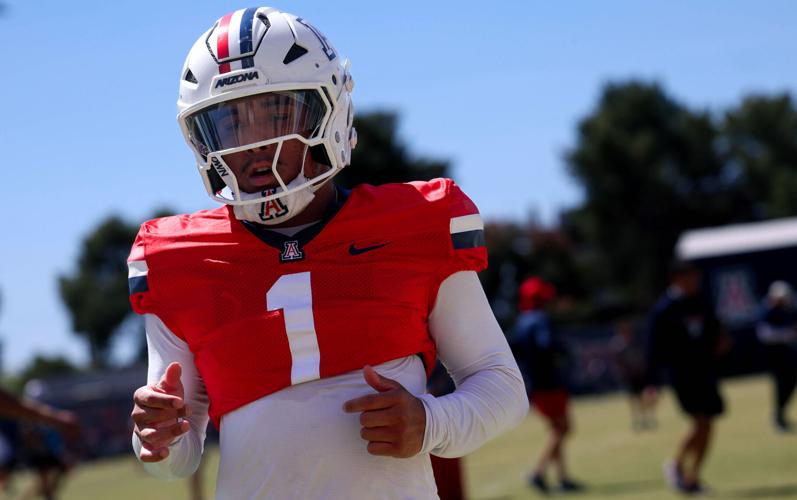
1. QB Noah Fifita is ready to level up.
Continuity was a big theme for Arizona this offseason, and you can tell that Fifita is benefiting from it. He’s playing in the same system as a starter in back-to-back seasons for the first time in his career, and his command of the offense is clear.
People are also reading…

Arizona quarterback Noah Fifita sprints into the end zone during spring practice at the Dick Tomey Practice Fields, April 6.
Two aspects of Fifita’s game stood out the most:
(1) Downfield accuracy: Fifita threw numerous deep balls that were right on the money — dropped over defenders with ideal arc and touch. Fifita ranked eighth among 12 qualifying Big 12 quarterbacks in adjusted completion percentage on passes with 20-plus air yards last season, , so he has room for improvement there.
(2) Finding checkdowns: Fifita completed a ton of passes to tight end Cole Rusk and tailback Wesley Yarbrough that weren’t very far downfield (more on them coming up). Veteran NFL quarterbacks do this all the time. It’s a sign of maturity.

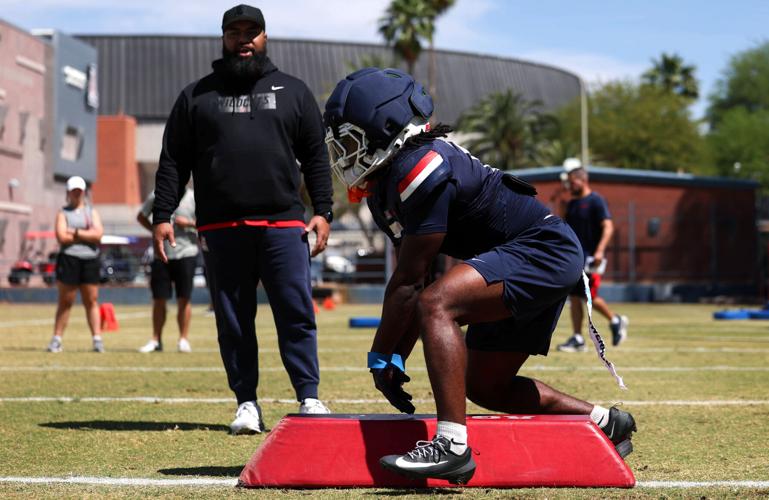
Arizona running back Wesley Yarbrough (0) participates in coordination drills during spring football practice at the Dick Tomey Practice Fields, April 21, 2026.
2. Wesley Yarbrough will be RB3 at worst.
The rising sophomore took full advantage of the absences of veteran backs Kedrick Reescano and Quincy Craig, who missed most of spring ball while rehabbing injuries. (Reescano did participate in individual drills late in camp.)
Yarbrough is thickly built at 5-10, 210 pounds. But don’t let those dimensions fool you. Yes, he’s powerful enough to plow through defenders. But he also has nifty enough feet to maneuver through traffic.
The aspect of Yarbrough’s game that appears to have grown the most is his pass-catching ability. We just didn’t see it last season, when he had 21 carries and one reception. During spring camp, he made several sideline catches that required high-level agility and hand-eye coordination.
Reescano and Craig will be back in the fall. Yarbrough is the leading candidate to step into the rotation. Reescano, Craig and the departed Ismail Mahdi each had 79-plus touches last season.
3. WR Tre Spivey has go-to-guy potential.
Fifita referred to Spivey as a “generational talent.� That’s quite a statement from someone whose best friend is Tetairoa McMillan.
Spivey has prototypical physical traits. He’s listed at 6-4, 213. He has enough speed to break away from defenders — which we saw last season, when he averaged 8.6 yards after catch per reception. (The next-closest UA wideout: Giovanni Richardson, 6.1.)
Spivey ranked only fourth on the team in targets, however, because he didn’t always execute his assignments when it came to alignment and route depth.
He has made significant progress in those areas and had a breakout spring camp, whether high-pointing deep passes or snatching throws in high-traffic areas between the hashmarks.
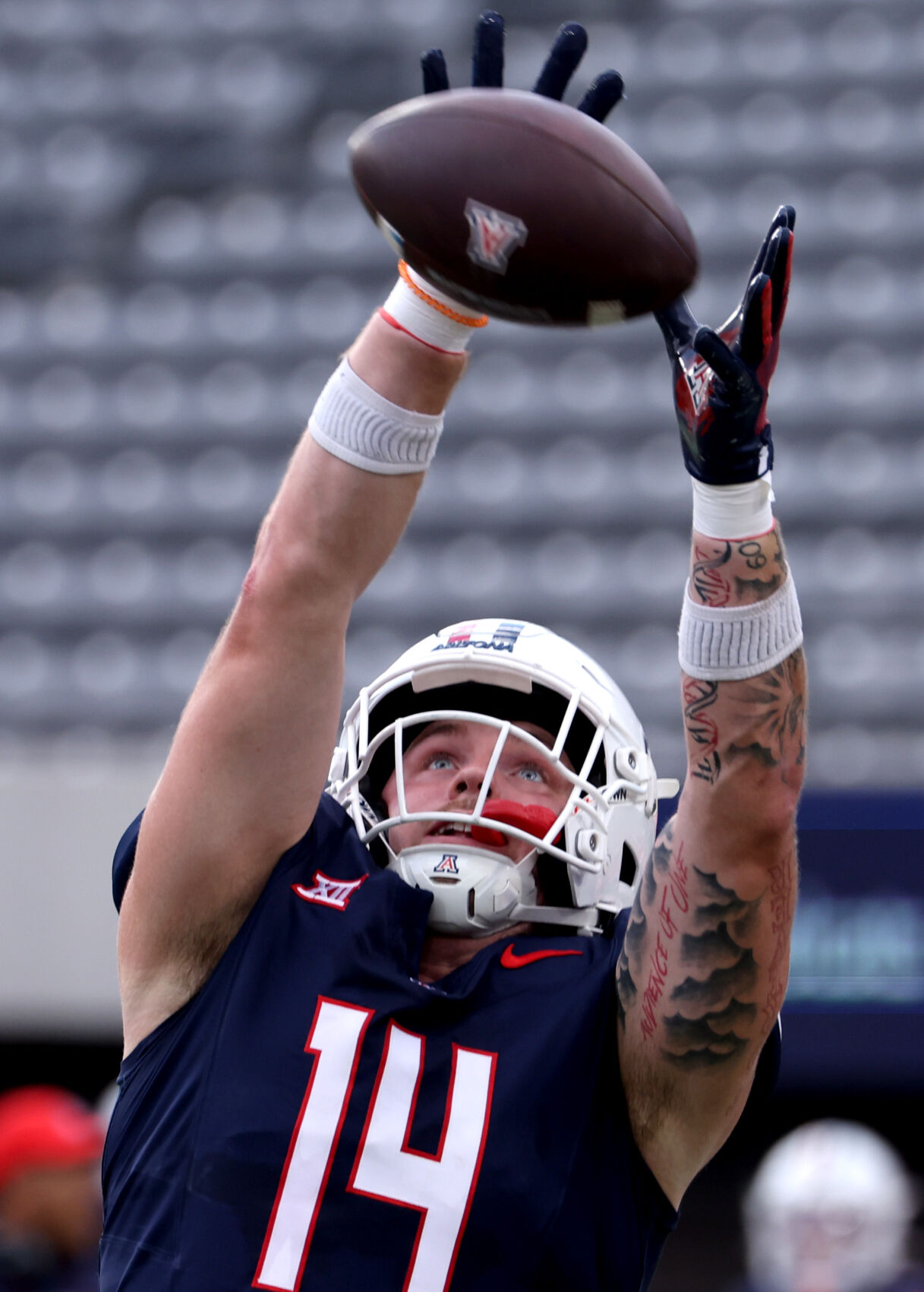
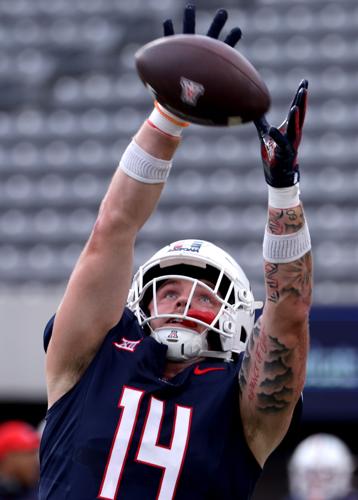
Arizona tight end Cole Rusk gets his hands on a high pass while running routes in a drill during the Spring Showcase, April 25, 2026.
Coaches say that Spivey is an attentive player and hard worker. My theory is that his longer learning curve is a byproduct of only becoming a full-time football player in college after playing multiple sports in high school.
4. TE Cole Rusk is a plug-and-play starter.
Rusk required no learning curve. He was ready to roll from the jump.
It makes sense when you consider how much college football Rusk has played. Rusk logged 642 snaps at Illinois and Murray State, per PFF. He’s in his sixth year of school, though, after redshirting at Eastern Michigan in 2021 and missing the '24 season because of a knee injury.
With Tyler Powell still rehabbing his knee injury and the other tight ends being underclassmen, Rusk became the starter in spring — and immediately established a connection with Fifita. Rusk caught a ton of passes on shallow crosses and out routes during the Showcase, and that was the norm throughout camp.
What kind of volume might Rusk see during the season? . Seventeen of his 19 receptions came in the final seven games, including eight in the last two.
5. Offensive tackle a lingering concern.
If all goes according to plan, Matthew Lado and Tristan Bounds will be Arizona’s starting tackles.
The coaching staff is taking a leap of faith with Lado, a big (6-6, 318), talented player who started the final three games last season with mixed results. PFF charged Lado with four pressures allowed in the Holiday Bowl and gave him a 30.9 pass-blocking grade.
The coaching staff likes what it has seen from Lado this offseason and believes his best football is ahead of him. That said, it was worrisome to see Lado get shoved back into Fifita on one of the final plays of spring camp.
Bounds missed spring ball while rehabbing a broken ankle suffered late last season. He was playing well before getting hurt, and his return for a sixth college season is unquestionably a boon.
The only worry with Bounds is whether the injury will affect him. TBD.
6. Youth again will be served on the D-line.
Mays Pese came out of nowhere last season to become a rotation regular. He was a three-star recruit who didn’t arrive on campus until June.
Four freshman defensive linemen participated in spring ball this year, and as many as three could contribute in the fall.
At one point during the penultimate practice, Prince Williams, Keytrin Harris and Kaisi Lafitaga formed the defensive front. All have a legitimate chance to play this season.
Williams has a similar build to Pese and a similarly high motor. Harris is cut from central casting at 6-6, 318, and is just scratching the surface. Lafitaga signed as an offensive lineman, moved to defense and appears to have the strength and bulk (6-2, 301) to hold up inside.
It’s risky to rely on freshmen. But barring injuries, Arizona won’t overextend them. They’re depth pieces — and it seems like they’re ready for that assignment.
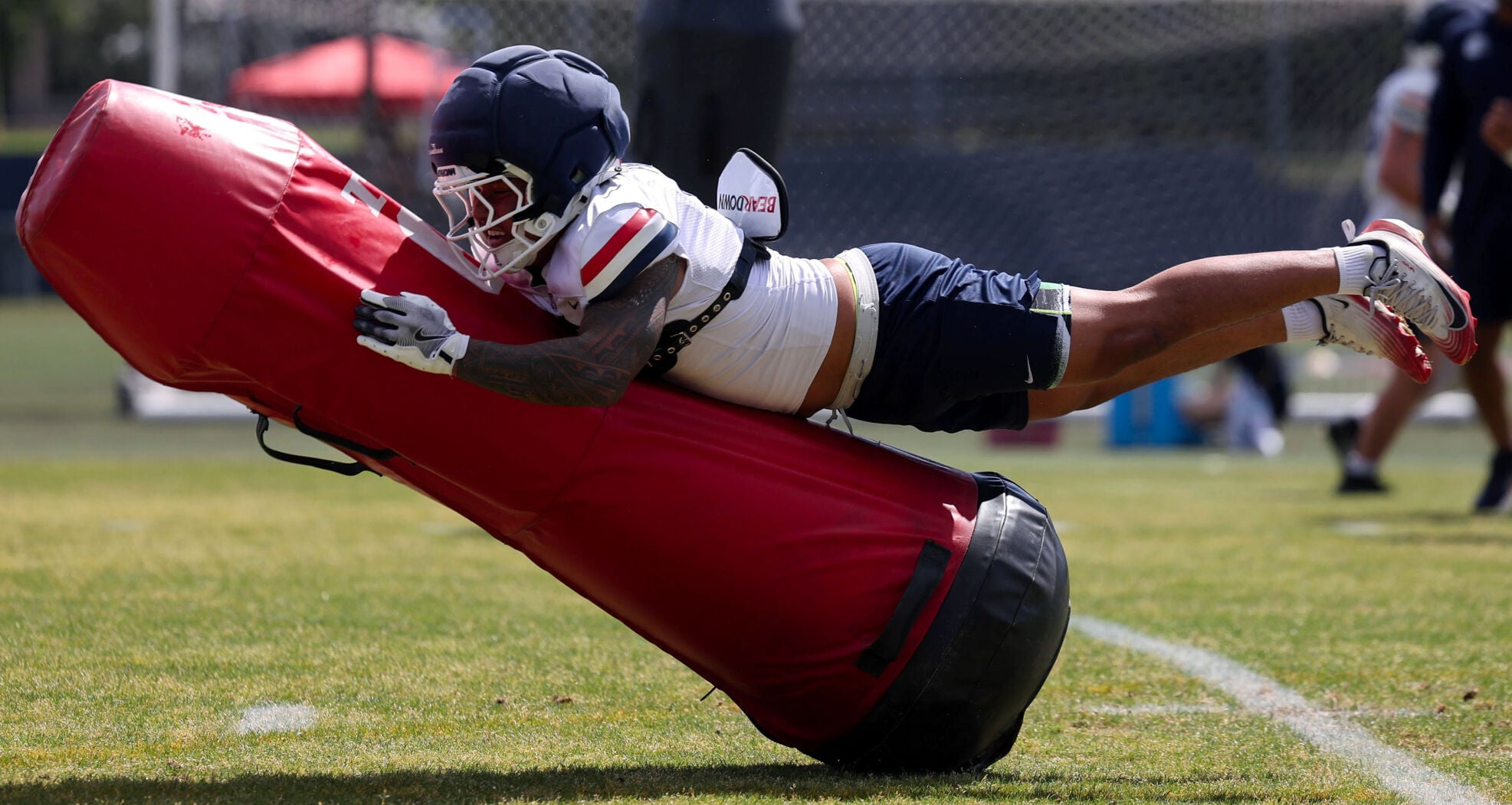
Arizona linebacker Dash Fifita tackles his target during hitting drills at spring football practice at the Dick Tomey Practice Fields on April 14, 2026.
7. Freshman LB Dash Fifita could be Manu 2.0.
If you thought the program was just doing Noah Fifita a solid when it signed his little brother, you thought wrong.
Dash Fifita is a baller. And he might be the most unconventional linebacker in college football.
Fifita is listed at 5-7, 186 — which would be undersized for a safety. Yet there he was during spring ball, knifing into the backfield and causing havoc.
Fifita did most of that work against the second-team offense, but who cares? For a true freshman to make that many plays against bigger, older players is incredibly impressive.
Coaches praised Fifita’s instincts, intelligence and toughness. He reminds me a lot of former UA linebacker Jacob Manu, who wasn’t much bigger but had a knack for finding the ball.
Whether Fifita carves out a role on defense this season remains to be seen; Arizona’s linebacker room is well-stocked. But I wouldn’t put it past him.
8. The secondary is still being sorted out.
Arizona arguably had the best pass defense in the nation last season. Four members of that secondary were drafted, and another signed as a free agent. That’s why the UA signed so many transfer DBs.
We saw some of them play during spring, but several sat out while recovering from injuries. They included three safeties: Daylen Austin, Cam Chapa and Malcolm Hartzog (who did participate early in camp before being shut down).
Two of those three could end up starting. A certain starter, returning cornerback Jay’Vion Cole, also was a minimal participant.
So we really have little idea what the secondary will look like come fall. But we can bank on this: The unit will be well-coached by Danny Gonzales, Brett Arce and Chip Viney. And it might be more athletic, overall, than last year’s stellar group.
That doesn’t mean it’ll be more productive. But it’s a starting point.
9. The Tim Tam fan is no flimflam man.
Arizona’s new Australian punter is legit.
Chase Ridley will be a field-flipping weapon for the Wildcats.
Did you see any of Ridley’s punts during the showcase? Most of them were majestic.
He hit several with elite hangtime and backspin that were downed inside the 10-yard line. He also launched one from the end zone that traveled about 70 yards in the air.
Ridley wasn’t perfect; he mis-hit a couple. But remember: American football is relatively new to him. He’s still learning.
Ridley has the talent to be Arizona’s best punter since Kyle Ostendorp. It’s an important role. A well-placed punt can make the difference in a close game.
Six of Arizona’s 13 games last season were decided by six or fewer points. The Wildcats went 3-3 in those contests.
10. The vibes around the program are positive.
This year’s spring camp was mostly uneventful — and that’s a good thing.
All but one on-field assistant coach returned, ensuring continuity. Brent Brennan’s culture has been firmly established. He’s more comfortable in his own skin. The tension that lingered into last offseason — following a 4-8 flop in Brennan’s debut campaign — is gone.
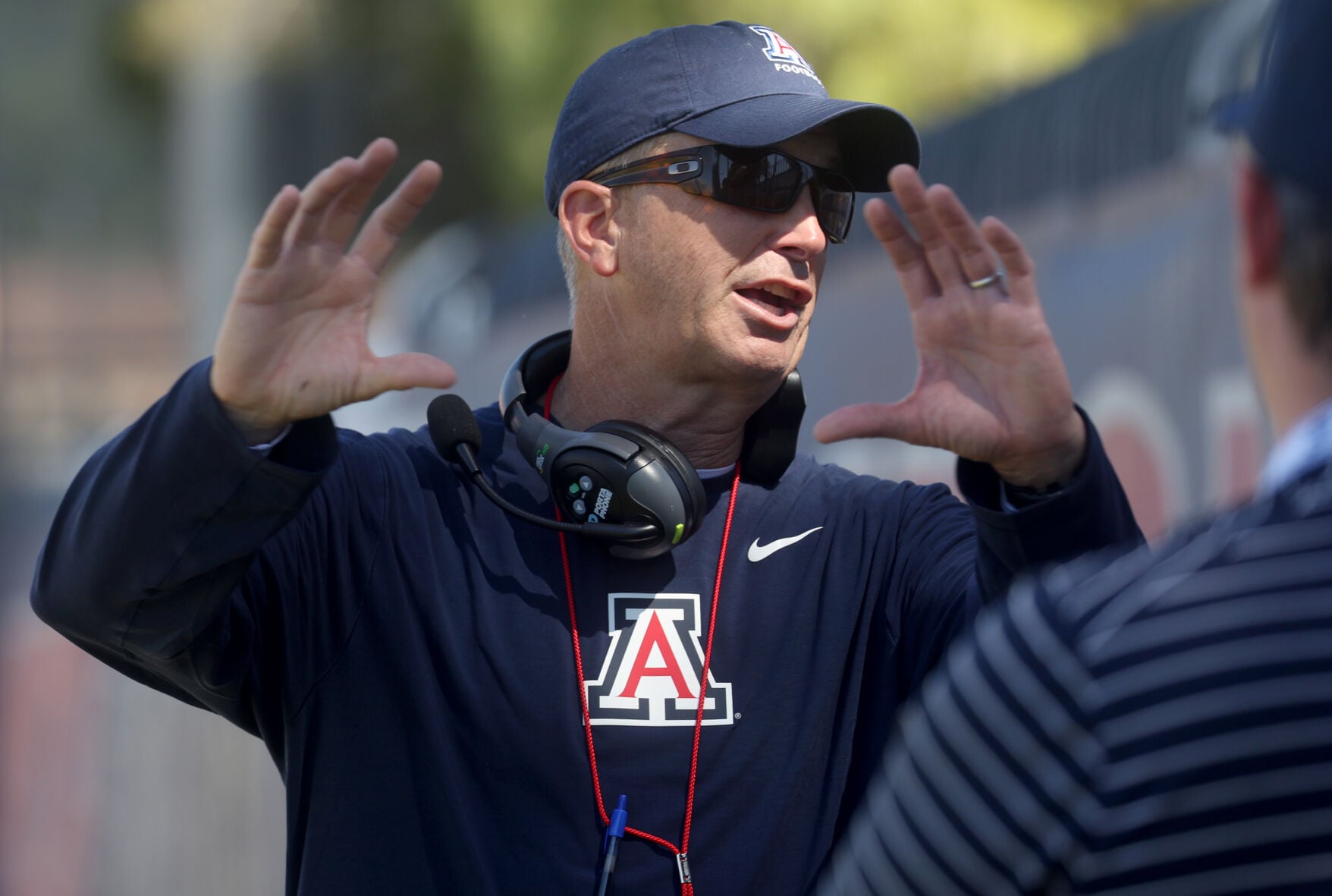
Arizona coach Brent Brennan talks with members of the media during a spring football practice in Tucson on March 24.
With all the coordinators back — plus Noah Fifita, the reigning first-team All-Big 12 quarterback — Arizona has to be considered one of a handful of favorites in the conference. We know how that can go.
Past UA teams have folded under the weight of great expectations. See 2024. Or 2015. Or 1999.
The last time the Wildcats won nine games in a season, 1986, they went 4-4-3 the following year.
(There were extenuating circumstances, as Larry Smith left for USC and Dick Tomey took over. Tomey turned out just fine.)
Why might this team be different? Stability. Fifita’s leadership. .
Is 8-4 a realistic outcome? Considering that Arizona’s over/under win total is 7.5, , it’s in the right range.
It also might be aiming too low.
Contact sports reporter/columnist Michael Lev at mlev@tucson.com. On X (Twitter): @michaeljlev. On Bluesky: @michaeljlev.bsky.social

Michael Lev
Sports Reporter/Columnist


 Detours and determination: How Francisco Rivero Jr. became a CDO baseball star, UA signee