Nobody knew it at the time, and couldn’t possibly know it for years later, but the elevation of Arizona men’s basketball into a national power and a cultural fixture in Tucson, arguably can be traced to the day Bob Elliott attended his first basketball camp at Concordia College in Ann Arbor, Michigan.
The Dave Strack Basketball Camp, it was called.
That camp more firmly bonded Elliott with Strack, who had coached Michigan to Final Fours in 1964 and 1965 before he triggered a celebrated basketball culture at Arizona as UA's athletic director.
People are also reading…
“My dad had multiple degrees from Michigan, including his doctorate,� Elliott said. “Anytime he’d come up there to get some tickets for a game, coach Strack would come down and tap me on my head and say, 'Dr. Elliott, I gotta have Bobby when he's ready to come to college.'
“I was 12 years old, so to have the head coach at Michigan talking to you was pretty impressive.�
Strack eventually did get Bobby, but for a different program and a different coach. By the time Elliott grew into a star at Ann Arbor’s Pioneer High School, Strack had moved on to become Arizona’s AD, though Elliott still kept a tight bond with Michigan in part through a Wolverines assistant named Fred Snowden.
Then, when Strack hired Snowden as Arizona’s head coach in March 1972, making Snowden the first black head coach of a major university, it was almost a done deal. Elliott, despite having some 300 college scholarship offers and Wolverine blood in his veins, was heading to Tucson.
A breakfast meeting at the Plaza International (now Aloft) Hotel during Elliott’s recruiting visit pretty much sealed it.
Strack and Snowden were there, as was UA president John Schaefer and an assistant coach who was once Elliott’s counselor at the Strack camp. Also, the heads of UA's business college and accounting departments.
“It was like 'OK, any question I have can be answered right here,'� Elliott said. “It was huge, because it showed me that they were interested in not only my athletic side but my academic side.�
Still, on the outside, it was almost crazy. Why would a decorated local star with lifelong and family ties to the University of Michigan go anywhere else, much less to an unproven program located far away from home, playing games in a time zone lost to the rest of the country, in a 3,600-seat arena known as Bear Down gym that sometimes had no atmosphere.
There was only one reason: The guy who already left Michigan to take over the Arizona program, Snowden.
If you "grow up in Ann Arbor, Michigan, with parents who both had multiple degrees from Michigan… everybody's wondering why'd you choose the desert?� Elliott said. “But in Ann Arbor,, they knew about Fred Snowden. They followed everything coach Snowden did out here.�
Then Elliott followed Snowden and the rest was … pretty much what Snowden said.
“Coach Snowden's pitch to me was 'Bobby, let's go west and let's make history,’� Elliott said.

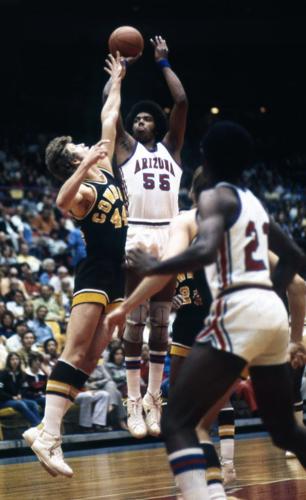
Bob Elliott could shoot from all over the floor, here playing against Wyoming at McKale Center in January 1976.
Others helped build that history, of course. Their names are still prominently in the UA record book: Coniel Norman, Al Fleming, Eric Money, Russell Brown, among them. But Elliott remains the program’s No. 2 career scorer (2,131) and rebounder (1,083), behind only Sean Elliott (2,555 points) and Fleming (1,190 rebounds).
Together, those guys helped Snowden take a team that went 6-20 in 1971-72 before he arrived into a program that won 60.7% of his games over a 10-year run. Under Snowden, UA made two NCAA tournaments and, more significantly, ignited a fan base that soon filled the new McKale Center when it opened in February 1973.
Elliott said he remembers hearing about three-figure crowds at Bear Down Gym before Snowden arrived, before everything changed.
"I remember them saying you could just walk in after halftime and nobody cared," Elliott said. “Coach Snowden sold out Bear Down Gym and then moved across the street to a 14,000-seat arena and sold it out."
The ground had been broken. Even during three straight losing seasons toward the end of the Snowden era, and a 4-24 campaign under coach Ben Lindsey in 1982-83, the potential was still obvious to some. Maybe no more so than to Lute Olson, who left Iowa to take over the UA program in 1984 and led the Wildcats to four Final Fours and the 1997 national championship.
“As a person who's part of the program, you want to see that development, you want to see where in ‘76 we went to Elite Eight and that was something new,� Elliott said. "We put more asphalt on the road for Arizona basketball."
After Elliott's four-year UA career from 1973-74 to 1976-77 ended, having spent his senior-year playing with an almost-secret knee injury, Elliott became a second-round NBA pick in 1997, and went on to an injury shortened six-year pro career. He then returned to Tucson to dig into his other passion, accounting, starting his own firm in February 1983 while also becoming a regular UA basketball television analyst.
A month after starting his firm, Elliott found himself on the other side of a recruiting pitch. But because of the foundation he and Snowden helped put down, it wasn’t all that tough either: He and then-UA athletic director Cedric Dempsey just needed to convince Olson to take the Wildcats up another notch.
“We're sitting in McKale Center and what I said to (Olson), and I would say today was'if you're just looking for someplace with warm weather, you could always go to ASU,'� Elliott said. “But I said 'if you want to go someplace where all you’ve got to do is re-light the fire, this is the place to come. Because coach Snowden lit the fire.'�
Two years after Olson took the job, he had the Wildcats in the NCAA tournament, while Elliott pointed out how Sean Elliott and Steve Kerr pushed the program forward in the late 1980s. Eventually, Olson and the Wildcats broke through, winning the 1997 national championship, thanks in large part to the leadership and clutch play of another one of the program’s greats, guard Miles Simon.
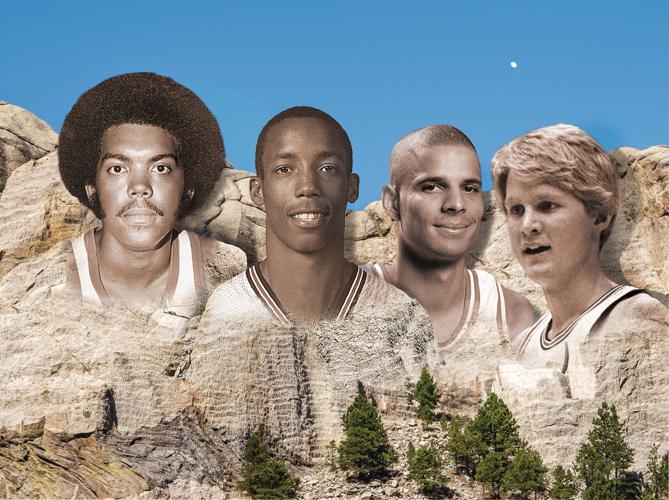
Arguably — very much arguably, since the Arizona basketball program has been loaded with accomplished players for decades — Sean Elliott, Kerr and Simon followed Bob Elliott as four of the program’s greats because of how they pushed the program forward, not because of what they did in the NBA, the stats they compiled nor just their sheer talent, earning each one a spot on the Mount Rushmore of Arizona men's basketball players.

The ÃÛÌÒÓ°ÏñAV's picks for the Mount Rushmore of UA men's basketball players. From left: Bob Elliott, Sean Elliott, Miles Simon and Steve Kerr.Â
Here’s a look at how those next three did their part in elevating Arizona men’s basketball:
Sean Elliott
Years at Arizona: 1985-86 to 1988-89
What he did: Even though Arizona has historically looked well beyond Tucson out of necessity to load its rosters with talent, the program’s best player ever came from none other than Cholla High School, just west of Interstate 10.
Elliott is Arizona’s all-time leader in scoring (2,555 points) and remains third in 3-point percentage (42.8), taking advantage of his unique inside-outside skills even more after 3s were allowed starting in his sophomore season of 1986-87.
Elliott led the Wildcats to their first Final Four in 1988, became a consensus all-American in 1988 and 1989, and won several national player of the year awards in 1989. During his college career, he joined with Kerr, David Robinson and several other collegians under Olson’s coaching to become the last amateur-only USA Basketball team to win a world title, the 1986 FIBA World Championship (now known as the FIBA World Cup).

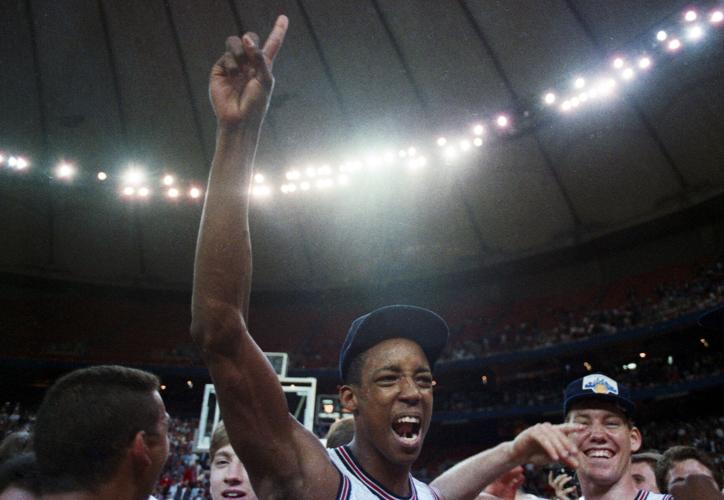
Sean Elliott and the Arizona Wildcats celebrate their Elite Eight victory over North Carolina in 1988. UA trailed at halftime but still won by 18 to advance to its first Final Four.
Elliott went on to become the No. 3 pick in the 1989 NBA Draft, helped lead the San Antonio Spurs to the 1999 NBA title and even returned to the NBA a year after undergoing kidney transplant surgery in August 1999.
Not surprisingly, his jersey was the first ever retired by Arizona in 1996, and after COVID hit in 2020, Elliott began work toward finishing up his final 27 units at Arizona. He became a UA graduate in May 2023, fulfilling a promise he once made to his mother.
Steve Kerr
Years at Arizona: 1983-84 to 1987-88
What he did: A class of 2002 Basketball Hall of Famer, Olson may be known most for UA's 1997 championship, five Final Fours (counting one at Iowa), coaching USA to the 1986 FIBA title — and his stately mannerisms — but he also excelled at something not discussed as much.
He was an astute evaluator of talent.
Who else would have even looked at the too-short, too-slow guard from Southern California's Palisades Charter High School in 1983 and decided he was worth a look, even if Olson was starting up a new program at the time?
Kerr was likely headed to Cal State Fullerton when Olson watched him in a workout, and saw flaws, of course, but also a knack for long-range shooting and a basketball IQ that was off the charts.
Kerr worked his way into the Wildcats’ rotation as a freshman and was a standout for his final three seasons, though he was shelved in 1986-87 after tearing up his knee during the 1986 FIBA World Championships.
While 3-pointers didn’t exist in college until that season, Kerr took full advantage as a redshirt senior in 1987-88, putting in 114 of 199 3s to set an almost preposterous school 3-point percentage record of 57.3.

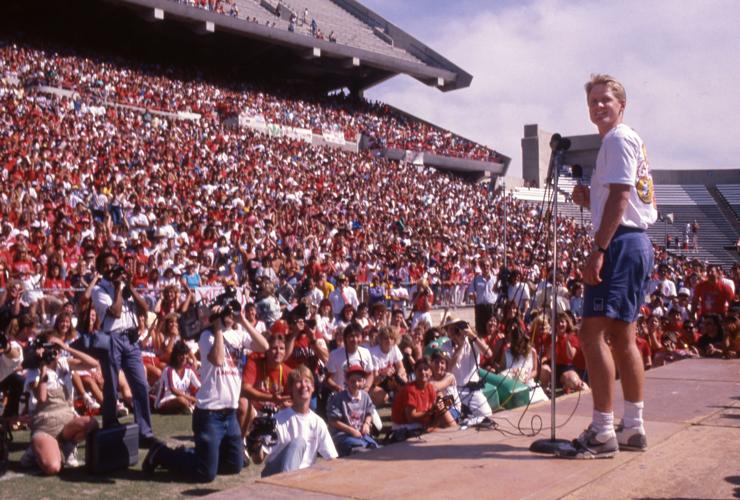
Steve Kerr addresses the crowd rally and parade for the men's basketball team at University of Arizona stadium after the 1988 NCAA Final Four.
Still, Kerr wasn’t known for raw stats as much as how he made others around him better.
That was a trait he took into the NBA, where he was again underestimated as the 50th pick of the 1988 NBA Draft — yet went on to win five NBA titles, three with the Bulls and two with the Spurs. Then he won another four as a coach of the Golden State Warriors, sewing together talent this time from the bench.
That’s nine rings in all, plus the 1986 FIBA title ... and the top role in leading the Arizona program all the way out of the Pac-10 cellar before Olson's arrival to its first-ever Final Four.
Ultimately, those are the numbers that define Steve Kerr.
Miles Simon
Years at Arizona: 1994-95 to 1997-98
What he did: A flood of more talented players followed — Richard Jefferson, Gilbert Arenas, Andre Iguodala, Aaron Gordon, Lauri Markkanen and Deandre Ayton among them — but college basketball is defined by its postseasons, especially Final Fours and national championships.

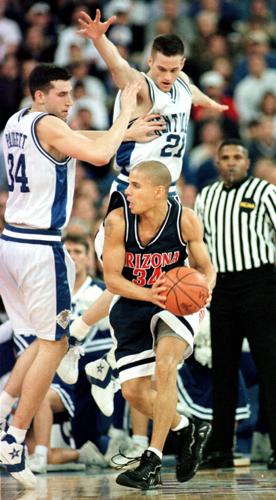
Arizona’s Miles Simon looks to pass under the pressure of Kentucky’s Scott Padgett and Cameron Mills during the 1997 NCAA College Basketball Championship game in Indianapolis, IN.
That’s where Simon made his name. After finishing fifth in the Pac-10 in 1996-97, the Wildcats made one of the most remarkable runs ever in NCAA Tournament history, becoming the only team to knock off three No. 1 seeds en route to the national championship: Kansas in the Sweet 16, North Carolina in the Final Four semifinals and Kentucky in the championship game.
Also notable in that run, but often lost in the national conversation: That the Wildcats survived a first-round scare against South Alabama and needed overtime to beat Providence and the will of God (Shammgod, the Friars’ star guard) in the Elite Eight.
Through it all, Simon was the undisputed leader, a confident, fearless shooting guard who played alongside freshman point guard Mike Bibby and wing Michael Dickerson, on the wing, while willing the Wildcats at several points along the way. He averaged 22.0 points, 4.0 rebounds and 2.2 assists during the 1997 tournament and was named the Final Four’s Most Outstanding Player.
That championship, in turn, gave Olson additional recruiting cred that helped pull in a stream of talent over the next decade, leading to a 2001 NCAA title game appearance, a 2002-03 season mostly atop the Top 25 polls and a 2004-05 season that ended in an Elite Eight overtime game.Â
After a dip just before and after Olson retired in 2008, the Wildcats' talent wave continued under coaches Sean Miller (starting in 2009) and Tommy Lloyd (2021).Â
In other words, Simon put down yet another layer of asphalt in the Arizona men’s basketball program that remains today.
Contact sports reporter Bruce Pascoe at bpascoe@tucson.com. On X(Twitter): @brucepascoe
Bruce Pascoe
Reporter


 The Mount Rushmore of Arizona Wildcats head coaches