The Tucson metro is the fourth most dangerous area for pedestrians in the United States.
The latest Dangerous By Design report, published by Smart Growth America in June 2026, moved Tucson from third on the list in 2024 to fourth in 2026. But the report also shows more pedestrian deaths from 2020 to 2024 than the several years prior.Â
“Our movement within the rankings doesn’t indicate anything because we’ve had more pedestrian fatalities since. It’s only because everybody else got worse,� said Vanessa Cascio, the executive director of nonprofit Living Streets Alliance.
The report shows that the Tucson region had 235 pedestrian deaths from 2020 to 2024 compared to 142 fatalities from 2015 to 2019.
Tucson follows three other cities located in the southern half of the U.S. The report ranks Bakersfield, California in third place; Albuquerque, New Mexico in second place; and Memphis, Tennessee in first.
People are also reading…
Arizona has a similar ranking to Tucson, ranking as the third deadliest state for pedestrians after Louisiana and New Mexico.
What makes some streets more dangerous than others?
Design and speed, the report says, are major factors making roads more dangerous.
Roads designed for speed in areas with homes, businesses and transit stops produce “deadly outcomes,� the report said.
Studies show that when a pedestrian is struck by a vehicle, their risk of injury and death is strongly related to the speed at which the vehicle was traveling.
According to the Insurance Institute for Highway Safety, an educational nonprofit, pedestrians struck at 20 miles per hour had a 1% chance of dying from their injuries. That's compared to over 80% likelihood of dying if struck from a vehicle traveling at 50 miles per hour.
Cascio said some ways to redesign roads for safety include decreasing the number and width of lanes to encourage people to drive slower.
Some argue that people crossing the roads while intoxicated is also a factor in pedestrian deaths. Cascio said the issue has to be looked at more holistically. Â
“Data shows this is systemic along certain corridors at certain intersections and it’s not always people who are inebriated,� she said. “I encourage us to really look at the system and not just the circumstances of individual crashes.�
She pointed to the importance of acknowledging that people make mistakes and building roadways with those mistakes in mind.
The report points to 34 countries in the developed world. It noted that other countries with similar issues, like drugs and alcohol, are succeeding in reducing roadway fatalities with dedicated investment, while the U.S. is getting worse.
“Every other country has cellphones. Every other country has alcohol. Every other country has risky, bad behavior. Other countries have weathered the chaos that came with COVID-19,� the report said. “There has been no great, uniquely U.S. crisis that would have crippled the ability to implement proven countermeasures here and achieve the same gains.�
How has Tucson improved road safety?
Cascio said Tucson has experimented with updating the design of certain streets and intersections.
One success story was the reconfiguration of South 12th Avenue from Irvington Road to Drexel Road, on Tucson’s south side.  Â
The project, conducted in 2020 by Tucson, decreased the road from five lanes to three, with one lane in each direction and a center turn lane. It also added on-street parking and enhanced bike lanes.
That road had two traffic fatalities before the project was implemented. In the two years after the road was reconfigured, there were no traffic-related fatalities – a 100% reduction. The area also saw a 44% reduction in total crashes, with an 84% reduction in crashes involving pedestrians, and a 100% reduction in crashes involving cyclists.
Cascio said she is seeing changes in the way this issue is addressed regionally.
Tucson has been a leader in looking at the issue, with the 2019 passage of the Complete Streets Policy, guiding street design. Now, other regional partners are starting to address road safety.
The Pima County Public Health Department declared roadway safety a top health priority this year, Cascio said. For priority health issues, the county works with task forces and coalitions to create action plans with goals and strategies to focus resources.
More funding is also going towards improving safety, Cascio said.
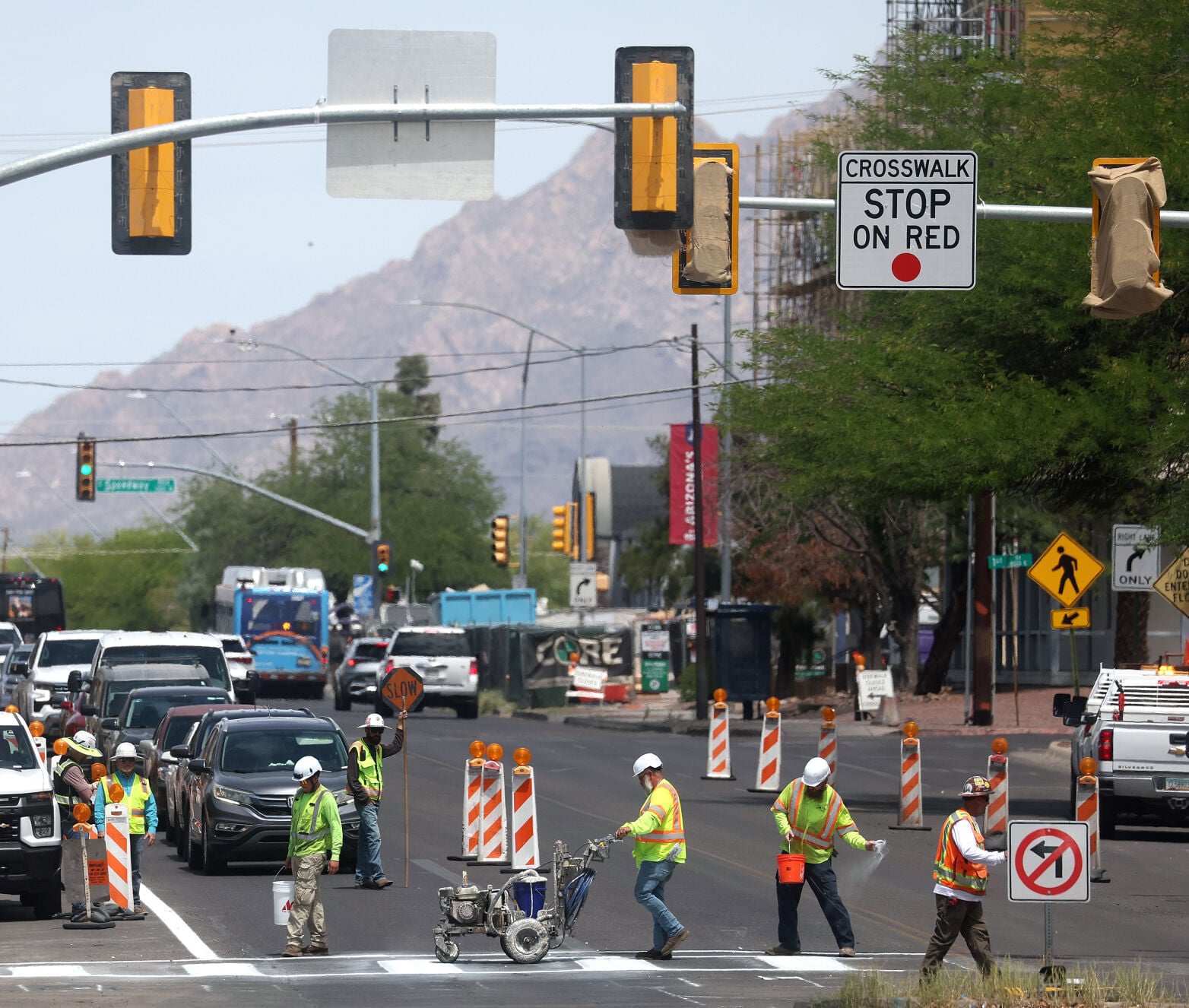
Proposition 411 passed by voters in 2022 to repave Tucson’s roads, and now the results are coming to fruition, she said. Â
Repaving roads, Cascio noted, offers an opportunity to assess a roadway for additional low-cost safety improvements like using pavement striping and reducing lane width.
Voters also approved extending a sales tax for regional transportation projects in March 2026 that allocated $255 million for safety improvements and $178 million for pavement rehabilitation.Â
“We have the tools at our disposal," Cascio said. "Keeping pace with implementing those tools is where part of the challenge is."


 Nancy Guthrie's Tucson neighbors: Life with streamers 'unbearable'