

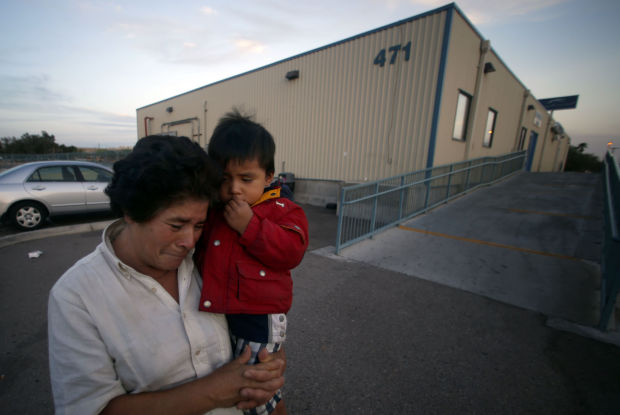

The Department of Homeland Security dropped off close to 200 immigrants 鈥� mostly women and children 鈥� at the Tucson Greyhound station this week, leaving them to find their own way to cities across the country to report to immigration offices there.
While such releases are not new, the number left here at the same time has put a strain on local immigration advocates and has customs and bus line officials working on a plan to accommodate the unexpected influx of travelers.
U.S. Immigration and Customs Enforcement in Arizona is processing 400 people, mostly families coming from Central America and Mexico who were apprehended in South Texas and flown here over the weekend, officials said.
To process the surge of crossers from Texas, the Border Patrol is turning to all available resources at its disposal, said Daniel Tirado , Border Patrol spokesman for the Rio Grande Valley Sector.
People are also reading…
In the first six months of the fiscal year, Border Patrol agents in that sector detained more people than Tucson did all of last year, with an average of more than 600 apprehensions a day.
In comparison, Tucson Sector Border Patrol agents have detained about 61,000 border crossers during the same period, with 18 percent coming from a place other than Mexico.
About 100 agents from other sectors, including Arizona, have been sent to Texas to help.
Border Patrol agents in less busy sectors are processing people by taking their biographical information and completing a file online And the Rio Grande Valley Sector is flying apprehended immigrants to other sectors where they can be processed.
The first flight was to El Paso on May 7. Four days later, the second one arrived in Tucson and the third landed here last week, not including those who arrived over the weekend.
The border crossers flown to the different areas of the border are prescreened. The first flights to Tucson were men traveling alone, Tirado said.
Because there鈥檚 limited bed space for families, women who pose no security risk are released with their children. They must provide the address of their U.S. destination, and they are required to report to a local ICE office near t hat destination within 15 days.
Tirado doesn鈥檛 know if there will be any more flights, but if agents continue to see the influx in Texas, 鈥渢hose resources available by all means will be utilized,鈥� he said.
Tirado couldn鈥檛 provide a per-flight cost estimate.
A group of about 30 people waited at the station late Tuesday, many thrusting their bus tickets at volunteers as they tried to figure out layovers and departure times to unfamiliar destinations across the country, including Maryland, Alabama and Florida.
Shortly before 8 p.m., two unmarked white vans dropped off about 40 more people in the Greyhound station parking lot.
ICE officials said they are working out a process with Customs and Border Protection to make sure each family is able to place a phone call to make travel arrangements, to provide them sack lunches and work with bus stations to help accommodate the influx.
鈥淯nfortunately, we do not receive prior notice and are unaware of when ICE plans to drop off individuals at our terminal,鈥� Lanesha Gipson, spokeswoman for Greyhound Lines Inc. said in an email. 鈥淗owever, we are currently working to establish protocol with ICE in which they inform us of drop-offs several hours in advance to ensure we have the resources to accommodate them once they arrive at our terminal.鈥�
For the last eight months, ICE has released large numbers of families at the Tucson Greyhound station while they await their immigration court date, but not in the volume seen this week.
A handful of local volunteers with Casa Mariposa have visited the station every night.
They provide food, phone calls and often put up families overnight when they are unable to get bus tickets.
The group, already operating at capacity, was overwhelmed with the sudden increase of immigrants left at the station.
鈥淲e think this is the right thing for ICE to be doing; we think they should be releasing people. But we just feel they could release them in a more respectful and responsible way,鈥� said Daniel Wilson with Casa Mariposa.
Jimena D铆az, consul of Guatemala in Phoenix, said her office was trying to find out what was happening Wednesday and had started to reach out to local churches and nonprofits to ask if they could help the families arriving at the bus stations.
鈥淚n general, immigration through Arizona has decreased, except for women and children. The same thing is happening in Texas, but the number there is much greater,鈥� she said.
鈥淲e don鈥檛 know what鈥檚 happening. It can be that they are told that if they come with children they are likely to be released for humanitarian reasons,鈥� she said.
Art del Cueto, president of the local Border Patrol union, said when agents ask people they just apprehend why they are coming, they often mention they heard about amnesty.
鈥淚t鈥檚 always been our issue, as agents, any time there are rumblings about amnesty it increases the flow,鈥� he said.
Paula Brise帽o Rodr铆guez waited for her daughter and granddaughter at the Greyhound station Tuesday. She had been released on Monday along with her 3-year-old son and spent the night with Casa Mariposa volunteers.
She had been traveling in a group that also included two nieces, ages 7 and 4, when they were detained by Border Patrol on Saturday. Immigration officials contacted the girls鈥� parents in Florida before taking them from her, she said.
Although she has a brother in Delaware who is a permanent resident and said he would try to bring her into the country legally, she said she couldn鈥檛 wait any longer.
鈥淥ne comes here because it鈥檚 hard in Guatemala. I left seven children to come here and try to do something,鈥� she said. 鈥淥ne earns 50 quetzales (about $6) a day. You have to eat, so you鈥檙e left with 20. How much is that in a week?鈥�
While the dream of a better life pushed many across the border, the fear of violence is also a concern.
鈥淚 was talking with a woman from Honduras who said they (gangs) killed three of her relatives on the same day,鈥� said Brise帽o Rodriguez. 鈥淎nother man told me you can鈥檛 open a small business anymore because they鈥檒l threaten you to get money and if you don鈥檛 pay they鈥檒l kill you or kidnap your child.鈥�
Concepci贸n Gonz谩lez and her two daughters, ages 7 and 6, also spent the night with a Casa Mariposa volunteer.
Gonz谩lez said she was in an abusive relationship that ended when her husband abandoned them. The memories brought her to tears.
鈥淢y husband would mistreat me and beat me,鈥� she said. 鈥淚 came here to start a new life. I just want to work, to better myself for my daughters because I鈥檓 their mother and their father.鈥�
Until last year, Tucson was the busiest sector in the country. At its peak in 2000, more than 600,000 people were arrested.
Back then, San Diego Border Patrol agents came to help here because they had experience dealing with high flows.
The difference, said del Cueto, is that Tucson remains a busy corridor. He said the agents being sent to South Texas are still needed here.
About 120,000 people have been apprehended in the Tucson Sector in the last two fiscal years. The sector still leads the country in the amount of marijuana seized. Last fiscal year, agents seized more than 1 million pounds, compared to about 800,000 pounds in the Rio Grande Valley sector.
鈥淭he Arizona border is still very much porous,鈥� del Cueto said. 鈥淭here are still areas where we have no fence 鈥� areas like the reservations where it鈥檚 like open fields.鈥�
Contact reporter Perla Trevizo at ptrevizo@azstarnet.com or 573-4210 and Luis F. Carrasco at lcarrasco@azstarnet.com or 807-8029. On Twitter: @Perla_Trevizo and @lfcarrasco.


