The federal judge overseeing Joseph Bongiovanni’s corruption case has postponed sentencing, previously scheduled for next week, and instead will hear arguments from prosecutors and defense lawyers about a presentence report that will shape his punishment.
The stakes are high for the convicted former Drug Enforcement Administration special agent.
If the judge accepts the defense team’s recommended changes to the report, the advisory sentencing guidelines would call for 21 to 27 months in prison for his corruption and drug convictions.
Should prosecutors prevail, the guidelines would call for up to 24 years in custody.
Rarely do judges encounter such a wide gap between prosecutors and defense attorneys over how long a defendant should be in prison.

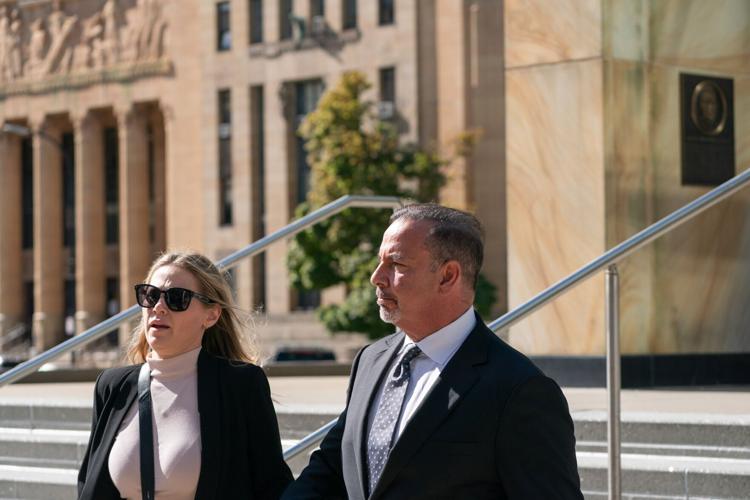
Joseph Bongiovanni and his wife, Lindsay, walk out of the Robert H. Jackson Courthouse after he was found guilty on seven charges in October 2024.
The presentence report, prepared by a probation officer, includes information about Bongiovanni’s crimes and his background, as well as recommendations for sentencing. The recommendations are advisory, so while U.S. District Judge Lawrence Vilardo must consider a sentence within the guidelines range, he is not required to impose one within the range. He can impose more or less prison time.
People are also reading…
The crux of the disagreement is the offense level score that the probation officer calculated to reflect the severity of Bongiovanni’s crimes. In presentence reports, these scores range from 1 for the least severe offenses to 43 for the worst crimes. Higher offense level scores lead to longer prison sentences.
While the report for Bongiovanni is sealed from public view, court filings commenting on the report reveal the stark disagreement between Bongiovanni’s prosecutors and his defense attorneys.
The defense team is pushing for an offense level score of 16. The prosecution supports a score in the upper 30s.
Defense attorneys Robert Singer and Parker MacKay said jurors in Bongiovanni’s retrial chose to convict him for:
- Protecting his best friend’s basement marijuana grow operation.
- Making false entries in DEA reports.
- Making false statements to investigators to minimize his relationship with Cheektowaga strip club owner Peter Gerace Jr.
- Taking a working DEA file home following his retirement.
His convictions did not involve a far-reaching drug-trafficking conspiracy that prosecutors set out to prove, the defense attorneys added.
“Simply put, the government’s motive now – as it always has been in this case – is to seek the most punitive sentence possible for Mr. Bongiovanni,� MacKay and Singer wrote in a court filing. “The government is doing this because it is angry that its multi-million-dollar crusade against Mr. Bongiovanni twice failed to produce the result it sought.�

Assistant U.S. Attorney Joseph M. Tripi described Joseph Bongiovanni in stark terms after his conviction, labeling as “corrupt� the former agent who had “violated his oath� and “protect(ed) those he should have been investigating and arresting.�
Meanwhile, Assistant U.S. Attorney Joseph Tripi said in his court filing that the U.S. Probation Office correctly calculated the much-higher offense level score for Bongiovanni.
Bongiovanni is essentially asking for the Probation Office to rewrite the presentence report “consistent with his spin of the facts,� Tripi said. The defense objections to the report should not be “a proxy to re-try counts of conviction on paper,� Tripi said. “Sentencing proceedings are not second trials.�
Trial testimony and exhibits established that Bongiovanni “was involved in a decades-long scheme to protect drug dealers who were his friends, and who the defendant believed has ties to Italian organized crime,� Tripi said in a court filing.
Over time, the Ron Serio-Michael Masecchia drug-trafficking organization – protected by Bongiovanni from 2008 through his arrest is 2019 in exchange for at least $250,000 – brought 10,000 pounds of marijuana, 5 kilos or more of cocaine and 16,000 fentanyl pills to Western New York, the prosecutor said.
“The court should properly consider the impact of the defendant’s abuse of trust in helping to victimize the Western New York community by helping drug dealers by protecting them from investigation, arrest and prosecution,� Tripi said.
Convictions and acquittals
Conflicting views of the verdict in Bongiovanni’s retrial have led to the sentencing dispute.
“It’s highly unusual,� Singer told The Buffalo News about the disparity in the competing sentencing recommendations. “And it’s really because the verdict lacks clarity.�
Jurors in October found Bongiovanni guilty on seven of the 11 counts he faced in U.S. District Court, making him the first DEA agent in Western New York convicted of corruption. But jurors acquitted Bongiovanni of one count that specifically accused him of accepting bribes from the Serio-Masecchia drug-trafficking organization.
What’s more, even though jurors convicted Bongiovanni of narcotics conspiracy, they found that the weight of marijuana that was “reasonably foreseeable� for Bongiovanni to know about was less than 110 pounds.
Had jurors believed Bongiovanni played a role in the thousands of pounds of marijuana that Serio sold across Western New York, they would have found that a much greater weight was proven in the conspiracy, Bongiovanni’s lawyers say.
Instead, the amount jurors cited was enough to cover only how much marijuana was grown at home by Louis Selva, a longtime friend of Bongiovanni’s and the best man at the agent’s wedding. Selva testified that he worked for the Serio-Masecchia organization and persuaded Bongiovanni to provide protection for it, eventually forging an agreement to gain sensitive law enforcement information from Bongiovanni for $2,000 a month and, later, $4,000 a month.
Prosecutors say the defense lawyers fail to acknowledge that Bongiovanni was convicted of jointly undertaken criminal activity, including conspiracy to defraud the United States and to accept bribes, spelled out in one of the counts the jury convicted him of.
The defense lawyers continue to advance a “baseless claim� that Bongiovanni was convicted of conspiracy to protect only Selva, even though the conspiracy-to-defraud count specifically names Masecchia as a co-defendant and the proof at trial showed that the large-scale drug-trafficking organization he protected included Masecchia, Serio, Selva and others, Tripi said in his court filing.
“Claims that the jury acquitted the defendant of protecting individuals connected to Italian organized crime or that he was acquitted of exposing confidential informants are not anchored in reality,� Tripi said.
At his retrial, jurors convicted Bongiovanni of four counts related to the drug-trafficking organization: conspiracy to defraud the United States; conspiracy to distribute controlled substances; and two counts of obstruction of justice.
His three other convictions related to Gerace, owner of Pharaoh’s Gentlemen’s Club: two counts of obstruction of justice, and one count of false statement to a U.S. agency. These convictions were over internal DEA memos he wrote and for what he told investigators about his past contact with the Cheektowaga strip club owner.

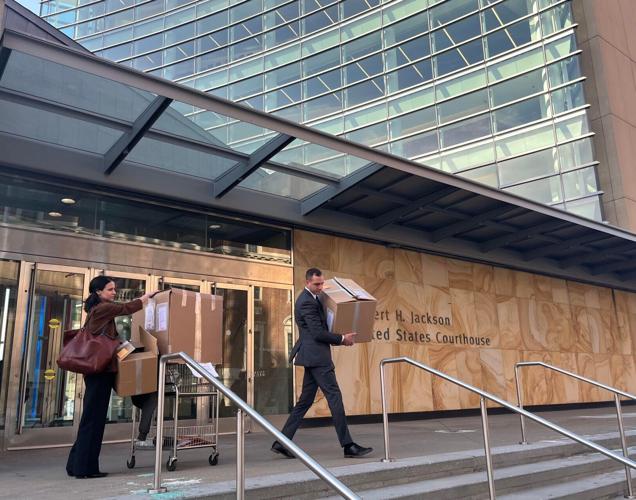
FBI agents carry out boxes of evidence after a day of testimony in the bribery and corruption trial of former DEA agent Joseph Bongiovanni. (Photo by Patrick Lakamp/Buffalo News)
Bongiovanni was found not guilty of one count of conspiracy to defraud the United States; one count of conspiracy to distribute controlled substances; and one count of obstruction of justice – all charges that named Gerace.
Ten days before Bongiovanni’s retrial, Vilardo acquitted Bongiovanni of a charge that he was paid an undetermined amount by Gerace to help Gerace and Pharaoh’s Gentlemen’s Club avoid federal narcotics investigations and induce the FBI to abandon an investigation.
At Bongiovanni’s first trial, a jury deadlocked on most of the counts, but convicted him of two charges over a DEA case file kept in his home after his retirement.
‘Broad scope’ of conspiracy
Selva testified that when he first approached Bongiovanni with the initial request for inside information, Bongiovanni turned him down, but reassured Selva that he would “have his back.� He also testified he told Bongiovanni where the organization’s Southern Tier marijuana grow operations were and who was involved.
After the initial rejection, Selva said he and Bongiovanni met again. While Bongiovanni was “hesitant,� he ultimately agreed to provide the drug organization protection, Selva testified.
Selva said that in exchange for $2,000 a month, the then-DEA agent agreed to alert the drug organization about any investigations or informants; if anybody connected to the organization was being followed or had been arrested; and whether law enforcement knew anything about the drug organization’s operations. He would let the drug organization know if it was at risk, Selva said.
Selva and Serio both testified that after a couple of years, the price for protection increased.
Selva said that as the drug organization’s operations expanded, so did the risks. The organization’s drug activity expanded into cross-country and international trucking shipments of marijuana – which included fentanyl pills inside the marijuana loads – and drug runs to New York City.
Bongiovanni agreed to be more vigilant, but the price went up to $4,000 a month, Selva said.
Tripi said Bongiovanni misled local, state and federal law enforcement agencies; exposed three confidential sources; misused DEA databases; revealed that tractor-trailer loads of marijuana from California and British Columbia were not being tracked; and “made a myriad of false statements� to his bosses and federal agents to conceal his role in the conspiracy.
The “broad scope� of his conspiratorial agreements were as described in Counts 1 and 3, for which he was convicted and detailed in the presentence report, Tripi said in his court filing.
Bongiovanni’s lawyers, however, said that the accusations that Bongiovanni’s conduct was “part of a systematic or pervasive corruption� may be what the government asserted in the indictment, “but it was not what the government ultimately proved at trial. The jury rejected these sweeping allegations.�
Patrick Lakamp can be reached