Arizona will receive $20 million in federal dollars to address PFAS "forever chemicals" and other harmful contaminants in the drinking water of small or disadvantaged communities, the U.S. Environmental Protection Agency announced May 19.
Just a day before, the EPA said it wants to drop the federal limits on drinking water for a mix of four of the forever chemicals and delay the limits on the other two. The standards for the six hazardous substances were established two years ago.

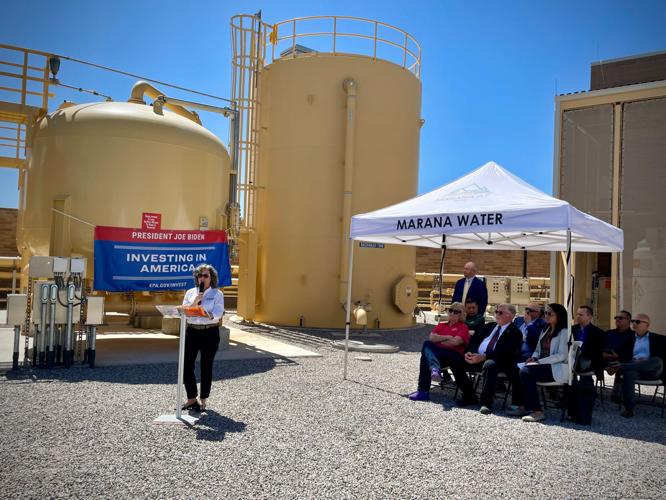
Karen Peters, executive deputy director at Arizona Department of Environmental Quality, speaks at a Marana event earlier this month. Local leaders and utility officials celebrated the new drinking water standards for PFAS substances and federal funding that will help public water systems protect public health.
PFAS, short for perfluoroalkyl and polyfluoroalkyl substances, are a large family of manufactured chemicals that have been widely used across industries for nearly a century. Long-term exposure is linked to severe health issues.
The federal funding is part of a national $1 billion annual appropriation that the former Biden-Harris administration earmarked for PFAS and emerging contaminants. This is the fifth and last year of that PFAS-specific grant funding. It's unknown whether there will be future funding for this purpose. The Trump administration announced the appropriation, established by law, as part of its commitment to Make America Healthy Again.
People are also reading…
EPA Region 9 expects to make the $20 million in awards available to states by late October, public affairs director Mike Alpern told The Republic. The funds will go to the Water Infrastructure Finance Authority and be managed by the Arizona Department of Environmental Quality, adding up to $104 million across five years. To date, WIFA and ADEQ have funded approximately 22 projects totaling about $8.5 M, a spokesperson for the agencies wrote to The Republic.
Environmental and public health advocates say rolling back regulations will put communities at greater risk, but EPA Administrator Lee Zeldin said the former administration "cut corners" to make the rules and they won't survive a court challenge.
The chemical industry, manufacturers and water utilities sued the agency, arguing the costs for complying would be prohibitive and passed on to consumers. U.S. Health and Human Services Secretary Robert F. Kennedy, Jr., said the administration wants to create a "clear water mandate."
Public awareness of PFAS chemicals has been growing in recent years but their health risks have been known for half a century. Ten U.S. states imposed drinking-water standards for PFAS, ahead of the national rules from the EPA, and many "forever chemicals" are banned and regulated around the globe. Arizona didn't have any standards for them until the 2024 federal rules.
PFAS are used in a variety of industries and are pervasive in soil and water across the world. Long-term exposure, even to low traces of these chemicals, has been linked to severe health issues like cancer, developmental effects and reproductive disorders.
Tracking PFAS water pollution in Arizona
In Arizona, 84 water systems have detected some PFAS above the federal limit. The Arizona Department of Environmental Quality has been testing drinking water for PFAS chemicals since 2018, and in recent years completed a sampling of 765 water systems across the state with $5 million in state funding allocated by Gov. Katie Hobbs and the Arizona Legislature in 2023.
Testing results are available at the agency's interactive map. Many of the water systems with one or more PFAS above the federal limit are next to airports, industrial sites or military facilities where PFAS-laced firefighting foam was used.
Treating water for PFAS is more expensive than treating for other regulated contaminants. Tucson has spent nearly $110 million in groundwater testing and treatment for PFAS chemicals; its upcoming PFAS treatment plant has a $33 million price tag. The most common technologies to treat PFAS so far are granular activated carbon, reverse osmosis and ion exchange systems. But there are also newer technologies, like "foam fractionation."
The challenge is huge for rural communities. About 90% of Arizona's public water systems serve less than 3,300 people. ADEQ works with operators to test water, inform the community, limit residents' exposure and find treatment or new sources of water. They also identify and prioritize systems with higher levels of PFAS and the greatest need for assistance to provide support.
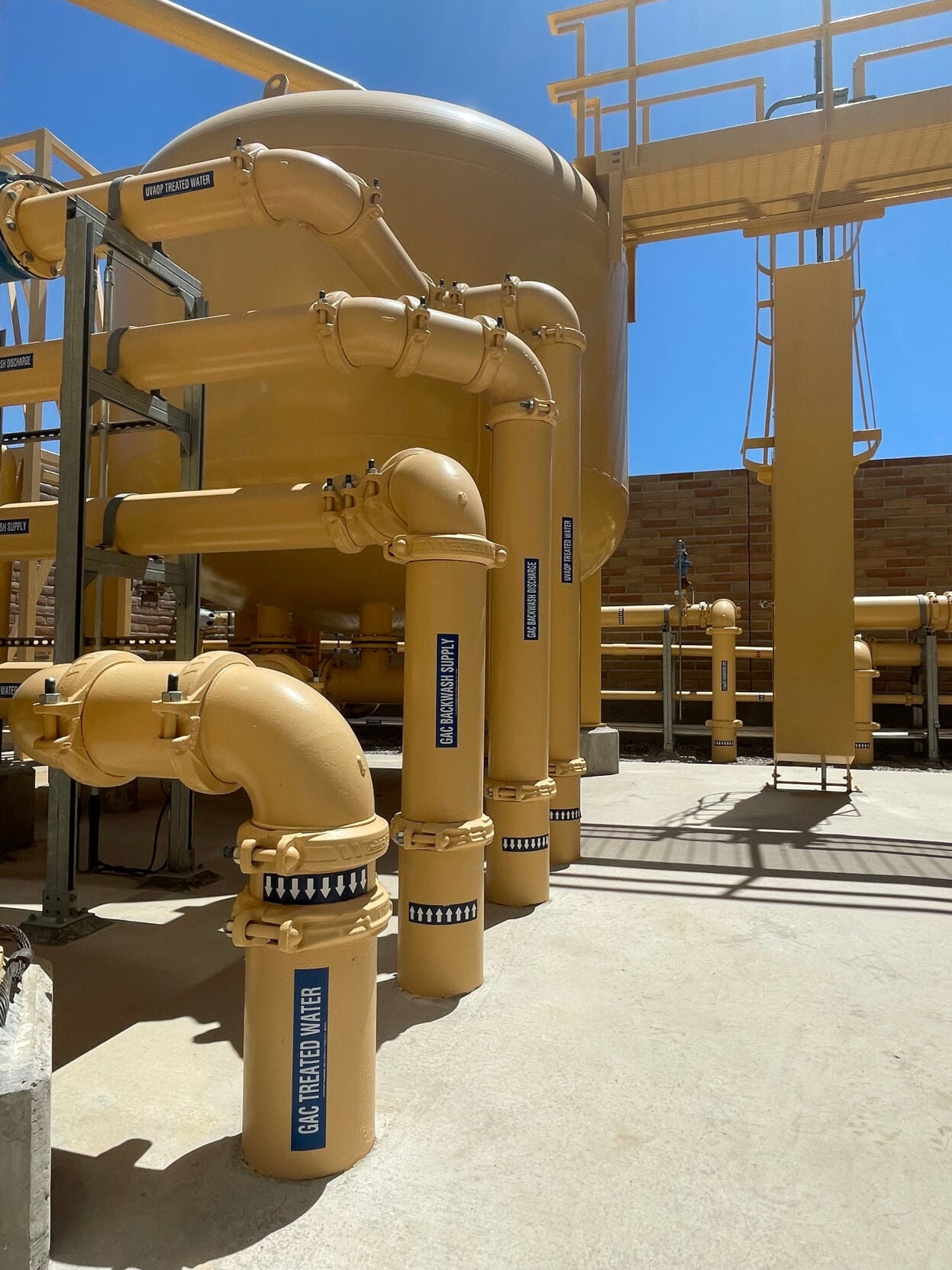
Marana's Picture Rocks Water Treatment campus is one of two treatment plants removing PFAS and 1,4 dioxane from drinking water. The facility, operating since 2021, treats water through a process that includes UV light, advanced oxidation, and granulated activated carbon filters.
Two mobile home parks outside Globe's city limits had wells with PFAS levels above federal limits, ADEQ testing found in 2023. The agency worked with the Globe and the town of Star Valley to connect those residents and two other small water systems, Houston Creek and Lil W. Ranch, to the municipal water supply, which meets EPA standards. They completed the $1 million project early this year.
Choosing interconnections over treatment and tapping into state funds is what allowed the agency to avoid passing the cost of PFAS compliance on to consumers, the agency said.
Because of the scale of PFAS contamination and the cost of treatment, bringing the country's water systems into compliance could cost over $1.5 billion every year, the EPA estimated. The negative health costs of PFAS water contamination could be of $8 billion a year, a University of Arizona-led study has found.The deadline for systems to reduce PFAS in their drinking water, if the level of chemicals exceeded federal standards, was 2029. Under the new EPA proposed rules, the deadline to achieve compliance for two of those chemicals, PFOS and PFOA, will extend to 2031 for systems that submit a request. Limits for PFNA, PFHxS, PFBS, and GenX compounds would be rolled back,
The EPA will hold a virtual public hearing on July 7.
What projects have been funded
With the fifth and last award of federal money of the Emerging Contaminants in Small or Disadvantaged Communities grant, ADEQ's total funding will add up to $104 million. With that money, the agency will pay for continued sampling, hydrogeologic studies, develop outreach, training and reference materials, and pay for projects to address PFAS drinking water contamination in Arizona.
To date, WIFA and ADEQ have funded approximately 22 projects across Arizona, totaling about $8.5M. Some of them are still in the design phase. Future phases, such as construction, are planned for many of the projects.
Projects will support testing and designing treatment systems, connecting smaller water systems to larger ones, and evaluating wells in conjunction with state funding.
Water systems, cities and towns funded to date include the Mayer Domestic Water Improvement District, Chino Valley, Payson, Prescott, Valle Verde Water Company, Yuma, Grandview Water Company, Globe Water Company, and several mobile home parks.