PHOENIX — Attorney General Kris Mayes will continue to pursue criminal charges against the 11 Republicans who falsely claimed to be the state's legally elected electors after the 2020 presidential race.
Mayes said Friday that she will seek Supreme Court review of a ruling that quashed the original indictment. It named not just those who signed certificates Donald Trump won the state in 2020 — he did not — but also seven others in the Trump orbit, including several attorneys and Trump's chief of staff from his first term as president, on felony charges of fraud, conspiracy and forgery.
Mayes contends they all were part of a scheme to undermine the results of the 2020 election by creating doubt about the results in Arizona and other battleground swing states by submitting paperwork claiming they were the legal electors. She said that was designed to get then-Vice President Mike Pence, who was presiding officer of the Senate, to refuse to accept the official results from Arizona and other states, preventing victor Joe Biden from getting the necessary 270 electoral votes, a move that could have allowed Congress to give Trump an immediate second term.
People are also reading…

Attorney General Kris Mayes
Mayes said Friday she remains convinced it is necessary to pursue the case to "uphold the law and protect Arizonans.''
"An independent grand jury of ordinary Arizonans found that there was sufficient cause to charge the defendants with the alleged crimes,'' she said in a written statement. "These defendants were charged based on two things: the facts and the law.''
Now she has to convince the state's high court to restore the original indictment.
Original indictment thrown out
Mayes could face an uphill battle. Maricopa County Superior Court Judge Sam Myers threw out the original indictment against all 18 earlier this year.
He ruled the grand jurors were not provided with a key piece of information that could have backed up the defendants' claim there was no intent to defraud: That the 1887 federal Electoral Count Act addresses the possibility of competing electors from a state and how Congress must handle them. The defendants contend that the election results in Arizona were not clear — there was a legal challenge at the time, which was eventually dismissed — and they were simply submitting the GOP slate to Congress should it turn out that Biden actually lost.
Myers' decision was upheld unanimously by a three-judge panel of the Court of Appeals.
It is that decision Mayes hopes to overturn, by telling the justices that the 1887 law is irrelevant to the case.

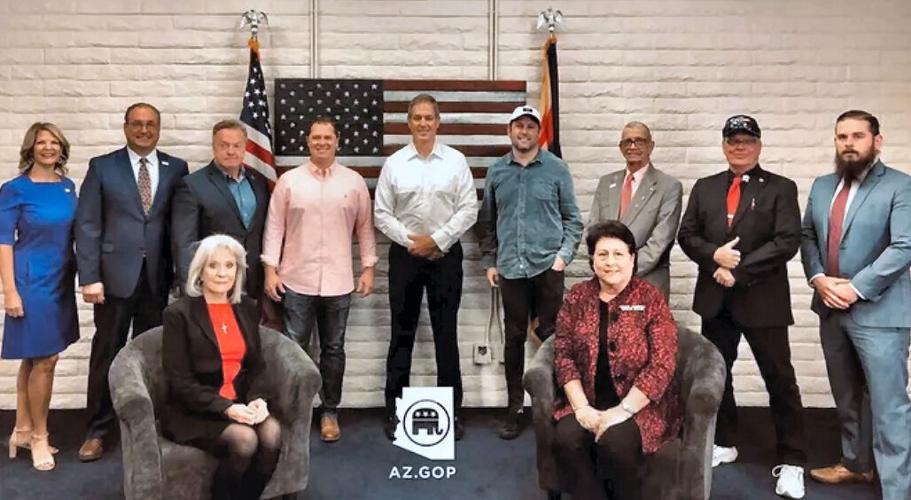
This 2020 photo from the Arizona Republican Party shows the 11 GOP electors posing for a group photo after they signed documents falsely claiming Donald Trump won the state in 2020 and was entitled to Arizona's electoral votes.
"The Electoral Count Act is a federal statute that provides no defense to the state fraud, forgery, and conspiracy charges,'' wrote Assistant Attorney General Nicholas Klingerman, who has been spearheading the prosecution for Mayes' office.
Klingerman also wants the high court to conclude that instructing the grand jurors on the federal law "would be misleading at best.'' He said it is legally up to a trial jury — and not the grand jurors, as Myers said — to determine whether the defendants' legal interpretation of that law is correct.
The defendants now have 30 days to respond.
Other challenges
Even if the high court agrees with Mayes, that does not mean the case will go to trial as scheduled next year, if at all. Â
First, there is another legal issue that must be resolved: whether Mayes violated the state's Strategic Lawsuit Against Public Participation law.
SLAPP, as it is known, is designed to prevent public officials from using the court to punish and prevent speech on political issues. Myers, in a preliminary ruling in February, said there was evidence the indictment appeared to attack what is "at least in part some arguably lawful speech.''
The judge at the time gave the Attorney General's Office 45 days to respond. But that issue was put on the back burner until it's decided whether the prosecution will proceed after the indictment was thrown out.
There's also a separate bid by Christina Bobb, one of Trump's former lawyers who was among those indicted, to have Mayes and her office disqualified entirely from hearing the case. She says that much of the case was prepared not by the Attorney General's Office but instead by States United Democracy Center.
At this rate, the case could run into the 2026 election season, where Mayes, a Democrat, is seeking a second term.
Defendants blast decision
The decision to try to get the indictment reinstated drew criticism from attorneys for state Sen. Jake Hoffman, a Queen Creek Republican who was one of the 11 false electors.
"The court has already made a preliminary finding that Mayes pursued the case to punish the defendants for lawfully exercising their constitutional rights,'' Hoffman's lawyers said in a prepared statement, referring to the yet-to-be-decided issue over the SLAPP law.
Hoffman's lawyers said dismissing the case would be "right and just for the defendants and the people of Arizona.''
Anthony Kern, a former state senator who also signed the certification, said Mayes is "wasting money.''
"If she drops the case and she loses, her base is going to be mad at her,'' said the Glendale Republican, who is trying to get back into the state Senate after an unsuccessful 2024 bid for Congress. "I get that,'' he said. "But how dumb can you be?''
Mark Williams, attorney for Trump lawyer Rudy Giuliani, called the case "frivolous, politically motivated'' and the appeal "a desperate Hail Mary to avoid a loss."
He said Mayes sought the indictment to punish his client and others "for their support of our great President Donald Trump'' and to discourage others from supporting him. He also said she did it "to advance her own political interests and those of the Democratic Party.''
Kurt Altman, who represents defendant Michael Roman, who headed Election Day operations for the 2020 Trump campaign, said while he was disappointed by Mayes' decision, it is "not surprising.''
"We're confident how this is going to end, and she's just wasting the taxpayer money,'' he said.
Mayes' decision has no effect on Jenna Ellis, one of Trump's attorneys, who also was indicted. Ellis already entered into a deal to have the charges against her dismissed based on a promise to cooperate with prosecutors.
Not affected is Loraine Pellegrino, one of the 11 electors, who pleaded guilty last year to a single misdemeanor charge of filing a false instrument. Her attorney, Joshua Kolsrud, said she wanted to spend more time with her husband, who had Stage 4 cancer, and did not believe she could fight the case and take care of him.
All this comes after Trump earlier this month issued "full, complete, and unconditional'' federal pardons to everyone connected with various efforts in Arizona and other states to overturn his loss in the 2020 election, including everyone Mayes has indicted.
That has no legal effect on the case here, however, as the defendants face charges of violating state laws.Â
Trump himself was not charged in the Arizona indictment but was named as an unindicted co-conspirator.
Howard Fischer is a veteran journalist who has been reporting since 1970 and covering state politics and the Legislature since 1982. Follow him on X,  and Threads at @azcapmedia or email azcapmedia@gmail.com.