PHOENIX — Calling it a matter of individual rights, Arizona lawmakers are moving to protect those who refuse to get vaccinated from being denied services or employment.
As approved on a party-line vote Monday by the Senate, contains a list of protections for those who refuse what the legislation calls "medical interventions.'' And that is defined as any medical procedure, treatment, device or drug taken to prevent or cure a disease.
The focus of the debate, however, is clearly on vaccinations. Proponents argue that there are dangers from many inoculations — and that people should be able to protect themselves without fear of discrimination.
A version of the bill already has cleared the House.
But what makes this legislation stand out is this goes beyond whether people can attend school or go into government buildings.
People are also reading…
The legislation also would make it illegal for any business to refuse to provide "any service, product, admission to a venue or transportation'' solely because the person has not received or used a "medical intervention.''
And if that isn't clear enough, HB 2248 gets more specific, applying it terms to any individual or entity that provides tickets to any "entertainment events'' including, but not limited to, sports and concerts.
There also are provisions against employment discrimination by both government and private entities. And it also would ban any government entity or official from requiring someone be vaccinated to receive any government benefit, service or a license or permit.

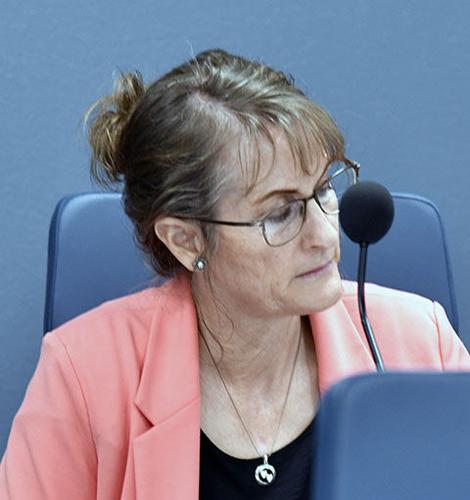
Fink
Rep. Lisa Fink said her legislation is grounded in the Declaration of Independence, pointing out this is the 250th anniversary of the signing of that document.
"Our founders declared that all people are endowed with unalienable rights, including life, liberty, and the pursuit of happiness,'' said the Glendale Republican. More to the point, she said it is up to the government "to secure these rights, not to override them.''
"This bill ensures that Arizonans are not forced to choose between their bodily autonomy and their ability to work, learn, travel, or to participate in public life,'' Fink said.
That theme was echoed by Sen. Janae Shamp.
"This is the United States of America,'' said the Surprise Republican. "The government does not have any rights to tell anybody what kind of treatment they should or should not participate in.''
And Shamp, who is a nurse, said there are reasons to let people make their own choices without fear of repercussions.
"How many drugs have been pulled off of the market because they have been found to have efficacy and safety issues?'' she asked.
"The time has come to stop shoving Big Pharma into our children and into our citizens,'' Shamp said. "And we, as the government, absolutely have the right to say our citizens live in a free state of Arizona and in a free country of the United States of America.''
But Sen. Lauren Kuby said she has a different view of the role of state lawmakers.
"Aren't we here to protect those most vulnerable?'' asked the Tempe Democrat.
That is in line with testimony provided to a House panel by Dr. Regan Hill.
He told lawmakers that, at age 4, he was diagnosed with a rare variant of childhood leukemia requiring years of chemotherapy. That illness and treatment regimen, Hill said, meant he did not have a normal functioning immune system from the ages of 4 to 8 years old, leaving him vulnerable to a host of infections.
But he said his family wanted him to have the experience of going to public school where teachers and others took care to protect him.
"Despite my bald head, the port (for medications) jutting out of my chest, and my steroid-bloated face and body, I got to learn math, reading and science as well as make memories with other children,'' Hill said. "That would not have been possible if my classmates weren't vaccinated.''
Shamp, in explaining her support of the measure, saw the issue of vaccinations through the lens of those who are being asked to get inoculated.
"How about the fact that we start talking about the fact that we no longer live in a time where measles kills children just simply because of the measles virus,'' she said. "We live in a time where we have treatment.''
A document from the , however, suggests that the virus is not that innocuous.
"Even in previously health children, measles can cause serious illness requiring hospitalization,'' the agency said in a clinical overview of the disease provided just last month for health care providers.
The agency also says one out of every 1,000 measles cases will develop acute encephalitis which often results in brain damage. And it says one to three of every child infected will die from respiratory and neurologic complications.
Shamp said, though, she believes people should be allowed to make the decision for themselves "because this is the United States of America.''
That argument got the attention of Sen. Analise Ortiz.
"If there are members of this body who think the government should not have a say in medical intervention or treatment or other medical health care, then I hope we keep that same energy for abortion, which is health care,'' said the Phoenix Democrat. And Ortiz said it goes beyond that.
"I hope we keep that same energy when people want to use birth control and contraception, which every member of the majority party voted against,'' she said.
That refers to an effort by Senate Minority Leader Priya Sundareshan to get a vote on her to statutorily guarantee a right to obtain and use contraceptives, as well as the ability of health care professionals to provide them. Senate President Warren Petersen, R-Gilbert, refused to even assign it to a committee for a hearing.
So last month Sundareshan, a Tucson Democrat, tried an end run, making a motion to bring the bill directly to the Senate floor for a vote. It was defeated on a 17-13 party-line vote.
Sen. Mitzi Epstein did not directly address the contention that people have a right to refuse vaccinations.
But the Tempe Democrat pointed out that the state imposes conditions on people who want benefits the government, like food stamps and temporary assistance for needy families.
"This is our societal construct, this is our contract with people,'' she said.
"If they want to get a public benefit, such as going to a public school, using a public road, there are things they have to do,'' Epstein continued. "It is not outrageous to require children to get a vaccine to go to a public school when there are plenty of other private options out there if you want to make sure that your child can go to a place where there are no vaccines.''
And that, she said, goes back to the kind of example cited by Dr. Hill where there are children who cannot be vaccinated.
"They desperately need us to keep a public school classroom as a safe place where their child can go and not catch a disease that could kill them,'' Epstein said.
But Sen. Mark Finchem argued all that ignores the fact that vaccines can be dangerous.
The proof, he said, is the National Childhood Vaccine Injury Act, a 1986 federal which provides broad immunity to manufacturers for certain injuries related to vaccines. Designed to ensure an adequate supply, it set up a no-fault system, funded by a levy on vaccine doses, where victims can get compensation.
But it does not recognize autism as a vaccine-related injury, with studies saying there is no proven link and that any increase over the years is due to better diagnosis and reporting.
Finchem, however, claims there is research linking vaccination with autism.
"That wasn't disclosed to parents before their kids were given any kind of vaccination,'' he said.
HB 2248 does have an exception to the ban on employers requiring workers be inoculated if a job requires foreign travel and that vaccination is the only way to legally gain entry into that country.

Howard Fischer is a veteran journalist who has been reporting since 1970 and covering state politics and the Legislature since 1982. Follow him on X, formerly known as Twitter, , and Threads at @azcapmedia or email azcapmedia@gmail.com.