PHOENIX — How many Arizona lawmakers is enough?
Sen. J.D. Mesnard says 90 — 30 senators and 60 representatives — is too few. So he is proposing to add 30 more to the state House.

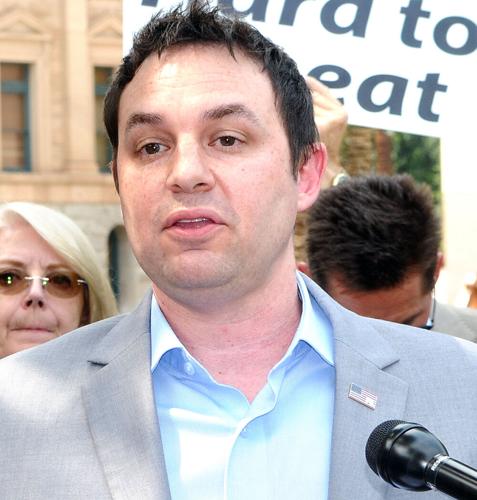
Sen. J.D. Mesnard
But there's more than pure addition to the proposal by the Chandler Republican who hopes to put the issue to voters in November.
The current system has two representatives for each of the 30 legislative districts. And both represent everyone in that district.
Mesnard would like to take those 30 districts and divide each of them into three. And then each of what would become 90 districts would have its own representative.
It's all about the numbers.
Right now, each district has about 254,000 residents. And that, he contends, makes it hard for any representative to truly get a feel for everyone in a district.
People are also reading…
Divide that into three and each House member would represent fewer than 85,000.
"This is about good governance,'' Mesnard said. "It allows for the House members to be a little more closer to the people.''
What his plan also is, he said, is bringing Arizona more into line with other states. Mesnard shared with colleagues a chart showing that the average state House has 110 members.
And then there's the fact that the 254,000 residents per representative is exceeded only by California, where each of their 80 member of the Assembly — the equivalent of the Arizona House — represents more than 491,000 constituents.
Still, he said, there are things to be worked out if the measure clears the Senate and then the House and, ultimately, if voters give their approval. It starts with having the new lines drawn by the Arizona Independent Redistricting Commission which meets after each decennial census.
There's also the question of cost.
Lawmakers currently make $24,000 a year, though there could be a measure on the November ballot to raise that. But even at that figure, plus the daily living allowance that legislators get, it would add $1 million to the state budget — not counting additional staffers that would be required.
And that's just part of it.
"I think the bigger question is, where do you put them,'' Mesnard acknowledged.
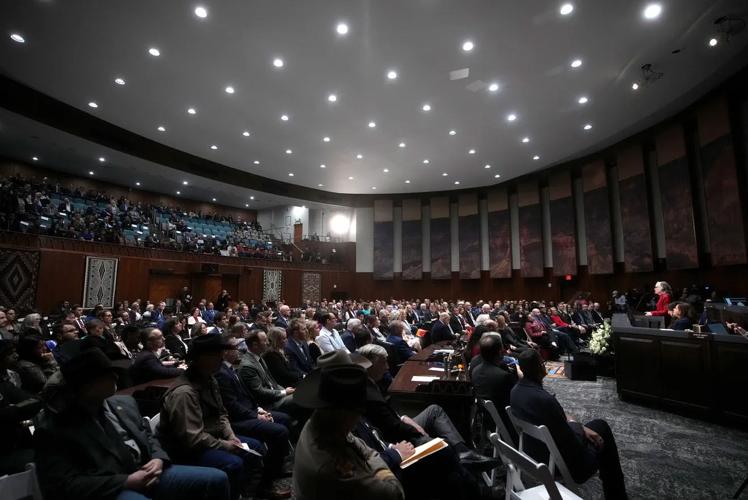
The current House chamber, built in the 1960s, is designed for the current 60 members.
Sen. Jake Hoffman said he doesn't see any reason that more lawmakers can't be accommodated. The Queen Creek Republican said there are "fancy desks'' for representatives, though they are no larger than the he and his other 29 Senate colleagues are assigned.
That, however, doesn't consider that each of the lawmakers would need an office.

And Mesnard acknowledged there could be construction costs, pointing to long-shelved plans to modernize — and possibly rebuild entirely — both the House and Senate.
Still, he urged colleagues not to think in terms of dollars and cents.
"If cost is the overriding factor, we can reverse it and shrink the size of the legislature,'' Mesnard said.
"It will be very efficient and very cheap,'' he said. "I don't know it would be very representative. But you can do that.''
Mesnard also pointed out that there is at least some precedent for what he is suggesting.
Prior to 1966, there actually were 80 state representatives, chosen according to a formula that assigned each county a certain number based largely on population.
All that fell apart after the U.S. Supreme Court issued a 1964 ruling that became known as "one man, one vote.'' In essence, the justices said that state legislative districts must have roughly equal population.
U.S. District Court Judge Roslyn Silver, in a 2021 article in the Arizona State Law Journal, said state lawmakers initially balked at drawing new lines, "likely because the legislators did not want to apportion themselves out of office.'' What it took, she said, was a successful lawsuit by Gary Peter Klahr, then a law student at Arizona State University, to finally get some action.
That resulted in the current 60-member House.
What it also did is reduced the influence of rural Democrats who, until that time, used the county-based system to control the process. And the House in 1966 went from being 45-35 Democrat to 33-27 Republicans — an edge that, to this date, the GOP has never lost in the lower chamber.
Sen. Lauren Kuby said she sees some benefit to what Mesnard is proposing.
"I believe it would increase representation,'' said the Tempe Democrat. She also said it could remove some barriers, financial and otherwise, for would-be candidates, what with having to knock on fewer doors and spend money mailing out campaign material.
"But I think it needs more thoughtful consideration,'' Kuby said. And for her, that means having some sort of study looking at all the possibilities instead of just going ahead now and asking voters to approve the plan in November.
"There may be other alternatives to reform a system,'' Kuby said as she voted against the plan when it went through the Senate Government Committee.
Mesnard, for his part, acknowledged the difficulty that remains even if voters approve.
His initial plan called for the new districts to be drawn up after the 2030 census. But the measure awaiting a final Senate vote, puts off any changer until the 2040 census, meaning the first time Arizona would choose 90 representatives would be in 2042.
He noted, though, that by that point the need for smaller House districts could be even greater, with the Arizona Office of Economic Opportunity saying by that year the state population could top 10 million. That would mean more than 330,000 residents of each district under the current system -- or 110,000 if the change is approved.
None of what is in Mesnard's plan would alter how state senators are chosen. There would remain just one for each of the 30 districts.
Howard Fischer is a veteran journalist who has been reporting since 1970 and covering state politics and the Legislature since 1982. Follow him on X, formerly known as Twitter, , and Threads at @azcapmedia or email azcapmedia@gmail.com.