Editor’s note: This is the second of a two-part series examining the day-to-day life and background of Desireé Reed-Francois in conjunction with her two-year anniversary as Arizona’s athletic director.
Desireé Reed-Francois remembers exactly where she was sitting when her brother was paralyzed.
A first-year law student at the University of Arizona, Reed-Francois was in Section 10 at what was then known as Arizona Stadium. UA was facing New Mexico in the second game of the 1994 season. She had a feeling that something had gone wrong.
Her aunt called to tell her she had to come home. Desireé’s younger brother, Roman Reed, had been injured while playing linebacker for Chabot College in Hayward, California. He had double-digit tackles and multiple takeaways, and it would be the last football game he’d ever play: Roman broke his neck while making a tackle.
People are also reading…

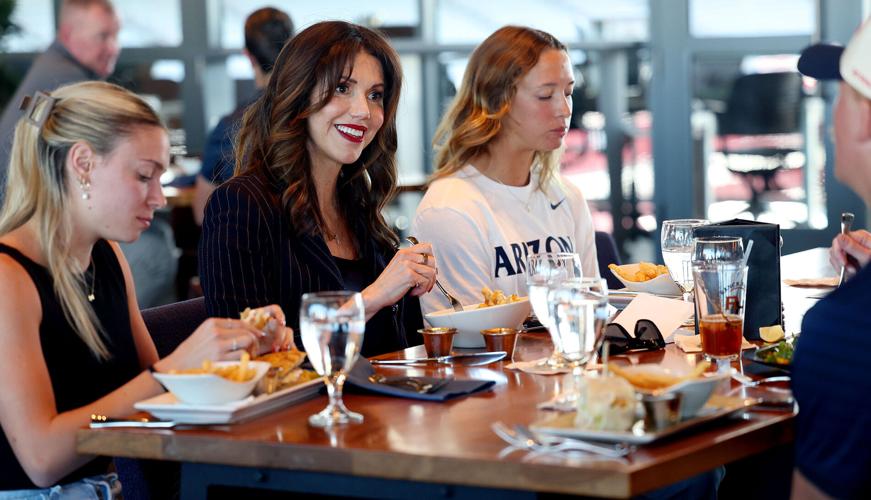
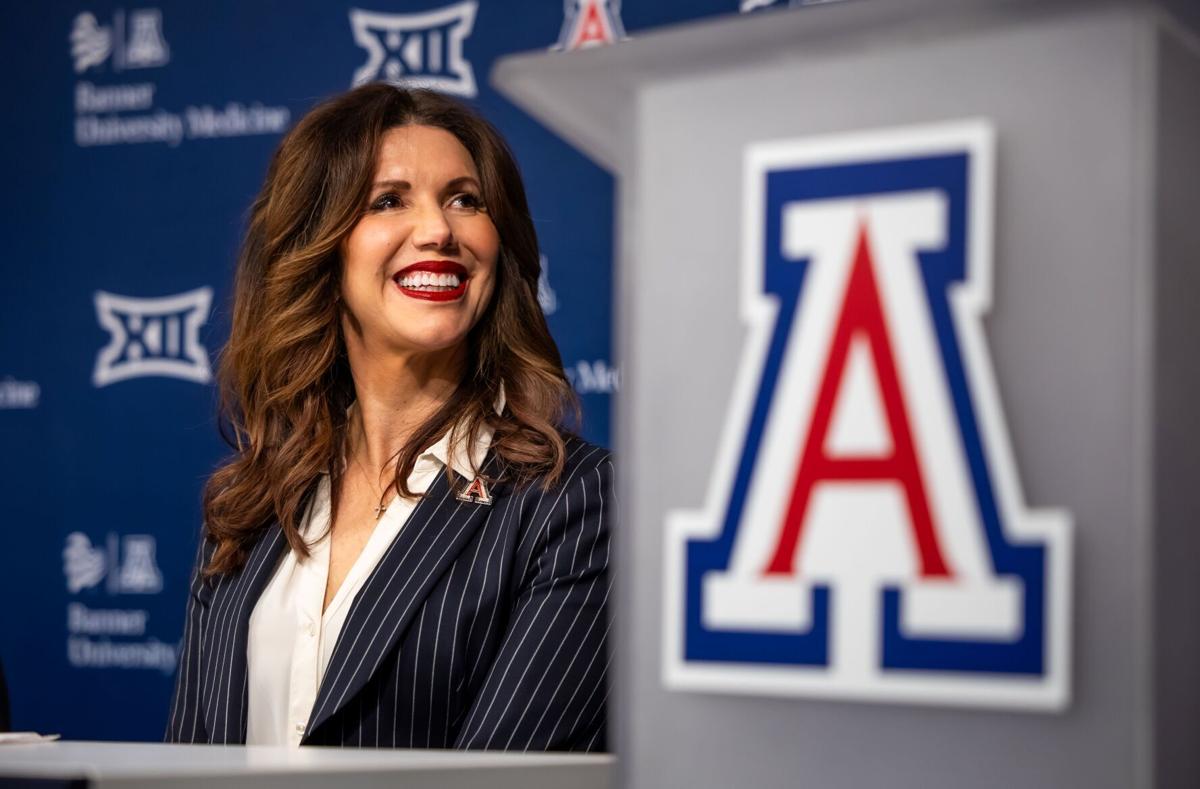
Arizona athletic director Desiree Reed-Francois, middle, listens to Garrett Hicks as he answers a question during a lunch with student-athletes she refers to as "Party of Five" at the Sands Club in Tucson, Feb. 4, 2026. Laina Friedmann, far left, and Tylee Shires are seated by Reed-Francois.
Reed-Francois has cited that moment as the inspiration for her career in college athletics, where the primary job of an athletic director — even in the world of realignment, NIL and the transfer portal — is to help and guide student-athletes. It certainly changed the lives of the Reed siblings, whose careers could have gone in wholly different directions.
Desireé had bold ambitions since she was in elementary school. She was in awe of her great aunt Mary, an attorney in San Diego.
“She was this elegant woman ... but commanding and so poised,� Reed-Francois said during a recent interview with the Star. “I asked my mother, ‘What is her job?’ She said, ‘She's a lawyer.’ I thought, ‘OK, that’s what I’m gonna be.’�
But not just a lawyer. Desireé imagined being Roman’s agent when he played professional football. Or, better yet, the first female general manager of the San Francisco 49ers, for whom Roman would play.

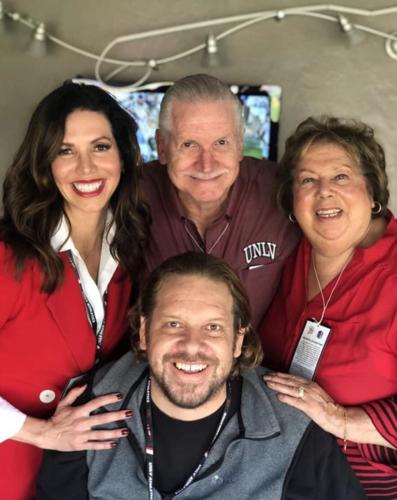
Arizona athletic director Desireé Reed-Francois, shown during her time at UNLV, is pictured with father Don (top), mother Gloria (right) and brother Roman (bottom).
“We didn't exactly understand how it worked,� Reed-Francois said. “But that's what I thought I was going to do.�
Sports and family
Desireé was born in Castro Valley, California, and grew up in Fremont. The Reeds were devoted 49ers and Oakland Athletics fans. Sundays in the fall for the Catholic family consisted of mass, breakfast and 49ers games.
In the summer, Desireé and Roman would take the BART from Fremont to the Oakland Coliseum to see the A’s, whose 1980s teams were loaded with stars such as Rickey Henderson, Jose Canseco, Mark McGwire and Dennis Eckersley. Desireé figured out that if they waited until the fourth inning, a security guard would let them in for free and they could spend all of the money their mother had given them on concessions.
“She always knew how to budget things,� Roman said in a phone interview. “From the very beginning, she would budget.
“We’d have banks. Hers was pink, mine was blue. Hers was full, mine was empty.�
Desireé’s very first job was cutting fish at a marine park. Don Reed, Desireé and Roman’s father, was a diver at Marine World/Africa USA in Redwood City.
“He would clean the fish tanks,� Reed-Francois said. “He was an underwater janitor.
“I swam with dolphins before I could walk.�
Don Reed later became an English teacher, an author and alongside Roman, who was told at the time of his accident that he’d never be able to have children or use his arms or legs again. The doctors were wrong about two of those three; Roman remains wheelchair-bound but has three kids and can bench-press 225 pounds.

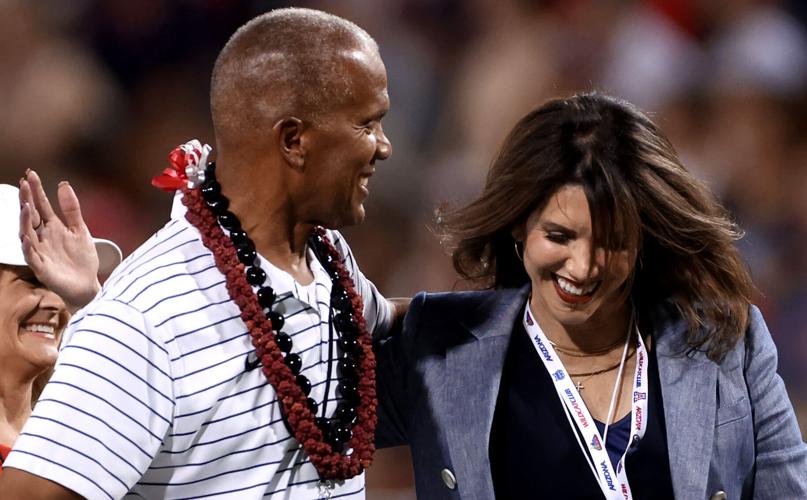
Former Arizona defensive back Randy Robbins walks off the field with Athletic Director Desireé Reed-Francois following his induction into the Ring of Honor during a break in action against Hawaii, Aug. 30, 2025, in Tucson.
Desireé and Roman have disparate personalities. While Desireé is careful about what she says and how she presents herself, Roman is unfiltered and speaks off the cuff. Their common trait, Roman says, is competitiveness.
Don’s wife, Gloria, was a school secretary who also was involved in special education. She died of pancreatic cancer on April 7, 2020. Her daughter was the athletic director at UNLV at the time.
The COVID pandemic was raging, but it brought a silver lining: Reed-Francois could work remotely from her parents’ house in the Bay Area and help take care of her mom in her final days.
“She was a strong woman,� Reed-Francois said. “Very kind, but very tough. And didn't accept excuses. ‘Get it done. We don't need complaining.’
“If you got straight A's, that was the expectation. It wasn't, ‘Oh, good job.’�
Reed-Francois’ description of her mother could apply to Desireé herself. She’s always been driven and serious.
“She got a B one time in high school. You would have thought the world had fallen over,� Roman said. “I would have been happy as hell to get a B. She was heartbroken.�
‘She’s nonstop’
Reed-Francois attended UCLA, where she earned a bachelor’s degree in political science, before going to law school at the UA. Her time as a law student overlapped with the Arizona men’s basketball team winning the national championship in 1997.
Reed-Francois graduated that year, passed the bar and became a lawyer, as she vowed. But she didn’t find the work as satisfying as she assumed it would be.
“I always wanted to do the next step and build,� she said.

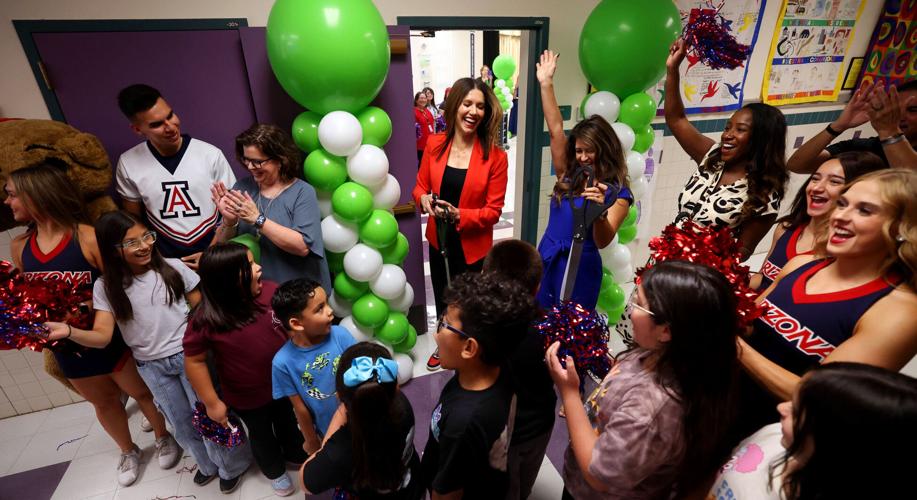
Arizona athletic director Desireé Reed-Francois, middle, and Sandra Calkins, principal at Mission View Elementary School, celebrate $50,000 in renovations made by the Big 12 and College Football Players Foundation alongside Arizona cheerleaders, football players and the students of Mission View, Oct. 2, 2025, in Tucson.
Another option eventually would present itself through happenstance — or perhaps by fate.
Roman was attending classes at Cal in the summer of '97. He didn’t have a power wheelchair. So Desireé, who hadn’t started her law-firm job yet, would help him navigate hilly Berkeley.
While Roman was in a class one day, Desireé came upon a salmon-colored building. She went inside and asked Dan Coonan, an assistant AD at the time, if he needed any help from a recent law-school grad. Coonan, who later became the AD at Santa Clara and is now , asked if she knew how to do a specific type of report. She said she did. (She didn’t.)
“All her decisions go into the big picture,� Roman said, noting that Reed-Francois’ career in athletics might not have materialized if she hadn’t been pushing his wheelchair that day and walked into that building.
“She doesn’t know how to rest. ... She’s nonstop. That’s who she is. She’s (just) programmed that way. She can’t chill out.�
Fast-forward a bit: A previous intern at Cal, Gloria Nevarez, was leaving San Jose State to return to Berkeley. She contacted Reed-Francois, who’d begun her law career, and suggested she apply for her job, in compliance, at SJSU. (Nevarez is now the commissioner of the Mountain West Conference.)
Reed-Francois found her calling in college athletics. (She also met future husband Josh at San Jose.) She especially enjoyed seeing student-athletes achieve more than they ever thought possible.
Sage words from Ced
Ironically, Reed-Francois remained uncertain about what she herself could accomplish in the industry. Then a wise man showed her the way.

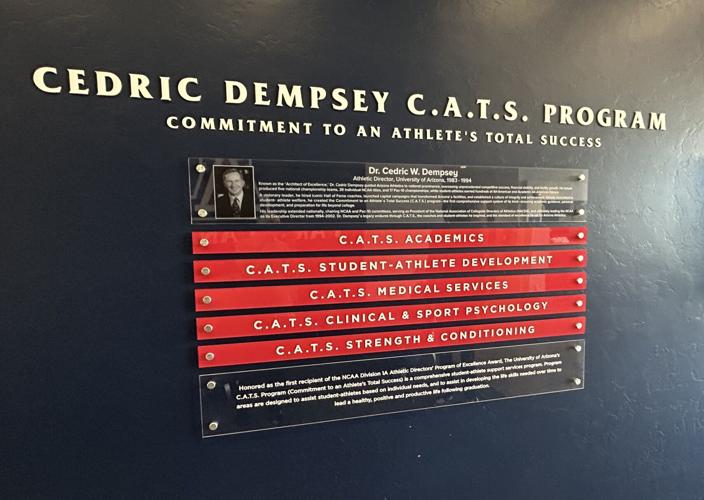
A wall inside the Ginny L. Clements Academic Center on the University of Arizona campus is dedicated to former athletic director Cedric Dempsey.
While working at Fresno State and pregnant with son Jackson, who’s a walk-on on the UA men’s basketball team, Reed-Francois had breakfast with Cedric Dempsey. was consulting on one of Reed-Francois’ projects at Fresno.
He asked her what she wanted to do long term. Reed-Francois wasn’t sure. She proposed becoming a senior administrator at one of her alma maters, UCLA or Arizona.
“Well,� Dempsey said, “why not the athletic director?�
Reed-Francois hadn’t viewed that as a realistic possibility. There were even fewer female athletic directors then than there are now. Dempsey urged her to reach out to one of them. Debbie Yow, who was at Maryland at the time, became Reed-Francois’ mentor.
Twenty years later, Reed-Francois is the athletic director at Arizona. Every day when she arrives for work, she walks past a navy-blue wall on the first floor of the Ginny L. Clements Academic Center. It’s dedicated to Cedric Dempsey.
Contact sports reporter/columnist Michael Lev at mlev@tucson.com. On X (Twitter): @michaeljlev. On Bluesky: @michaeljlev.bsky.social
Michael Lev
Sports Reporter/Columnist


 ‘Controlled chaos’: A day on the job with Arizona AD Desireé Reed-Francois | Michael Lev