PHOENIX — Arizonans are about to have fewer loose coins in their pockets.
As of right now, it's legal for Arizona merchants to round up — or round down — the amount of change you get when customers pay in cash. And that will mean is a bill that will end up a little bit more — or a little bit less than the actual price.
All this is because Gov. Katie Hobbs has signed legislation to make official what some retailers have been doing informally now for months since the federal government stopped minting pennies.
The idea was so popular that there were more than enough votes to include an "emergency clause'' to have it take effect immediately on her signature.
What's important, said Rep. Teresa Martinez, is consistency.
The Casa Grande Republican told colleagues that McDonald's restaurants "will keep the penny for itself.'' By contrast, she said, cash shoppers at Fry's get the benefit of having the final bill lowered.
People are also reading…
So what this does is require Arizona merchants to follow what has become known as "Swedish rounding,'' named for the first nation that came up with the plan after phasing out its own small coins.
It works this way: If the final tab ends with a 1, 2, 6, or 7, the bill is rounded down to the nearest nickel; a bill ending in 3, 4, 8, or 9 is rounded up.
And just so there are no questions — or complaints — the new law requires a sign spelling out "cash transactions are rounded to the nearest five-cent increment pursuant to state law.''
What's behind all of this is the fact that the government finally decided last November that producing pennies was, literally, a money-losing business.
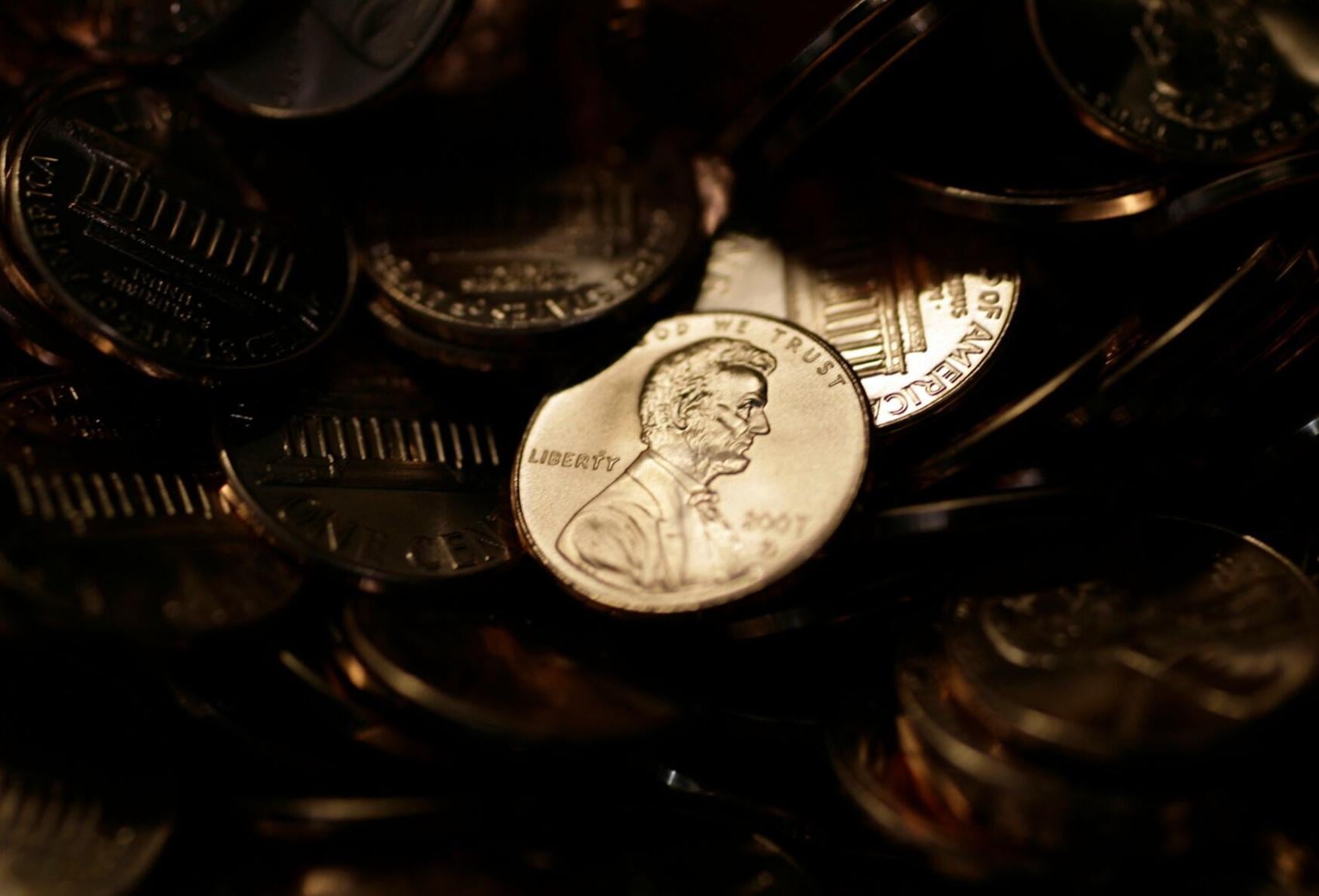
When it comes to pennies, Arizona Gov. Katie Hobbs has signed legislation that allows merchants to round up — or round down — the amount of change you get when paying in cash.
The U.S. Mint did what it could to curb costs as far back as 1982, when it stopped using pure copper after the cost of that metal skyrocketed. After that, all new coins were made almost entirely of zinc with a thin layer of copper.
Still, that didn't help much. It still costs 3.7 cents to produce a one-cent coin.
So now the penny is history — sort of.
Nothing in the new law makes pennies illegal in Arizona. And merchants are free to accept them and even give them out as change.
But there is also nothing in the state legislation that actually requires retailers to accept them. And the Federal Reserve Board says there is no federal law mandating that any private business must accept current or coins as payment for goods or services.
There are some safeguards for consumers built into the new law.
One is that the rounding occurs only on the final bill and not on each individual item in the basket.
The other is that there is no rounding for customers paying with credit or debit cards or any other non-cash form. The merchant has to charge the exact amount.
Still, there were two legislators who voted against it.
One was Rep. Mariana Sandoval. The Goodyear Democrat told Capitol Media Services she remains unconvinced that cash customers won't end up shorted over the long run.
She says many bills seem to wind up ending in 98 or 98 cents. And the new law means all those bills will be rounded up.
"There is a big cash population, especially in the Latino and the undocumented communities,'' she said.
"People work really hard for their money,'' Sandoval said. "And even if it is one or two pennies, if you add it up over time, it could affect them.''
The other dissenting vote came from Sen. Sally Ann Gonzales. That, however, was not a surprise: The Tucson Democrat routinely objects to the use of emergency clauses.
Such a clause does more than mean immediate enactment. It also deprives Arizonans who may not like what the legislature has done of a constitutional right they have on every other bill: The ability to gather enough signatures to refer it to the ballot and hold up enactment until voters have the final say.
Howard Fischer is a veteran journalist who has been reporting since 1970 and covering state politics and the Legislature since 1982. Follow him on X, formerly known as Twitter, , and Threads at @azcapmedia or email azcapmedia@gmail.com.